
I. Overview and Framework
This analysis does not examine Santa Cristina in isolation. It is interpreted within a comparative framework that includes the Giza pyramid complex, Peruvian megalithic sites, the Barabar cave complex, and other sites referenced throughout. Across these geographically and chronologically separated locations, a consistent systemic architecture recurs: directional signal capture, impedance-matched amplification stages, resonant terminal chambers, and construction precision that cannot be attributed to incidental craft. The hypothesis is that these sites are expressions of a shared design logic — a distributed network implementing coordinated acoustic functions.
I am an industrial designer of about 20 years — a discipline that is engineering-adjacent by necessity. We work directly with engineers, specify materials and tolerances, design for manufacturing processes, and develop functional understanding of mechanical, electrical, and structural systems as a routine part of practice. This analysis reads ancient construction the way a designer reads any object — for evidence of intent. What was this solving? What does the geometry require? Where does the precision exceed what the stated function demands? These are design questions, and the training to ask them rigorously does not require an engineering degree.
In order to get a clean view of this site, the analysis proceeds from geometry, material, and construction precision alone. Every feature is examined for its potential function — not filtered through the presumed sacred, ceremonial, or primitive uses conventionally attributed to ancient sites. That framing is set aside entirely. The question asked of each element is simply: what does this shape do?
The mechanisms described here are morphological analogies identified through geometry, not calculated models. Where the claims and analysis are wrong, correction is invited. What is not wrong is the observation that this structure is engineered — that every feature is deliberate, that the deliberateness is systematic, and that the system has no adequate explanation under the conventional interpretation.
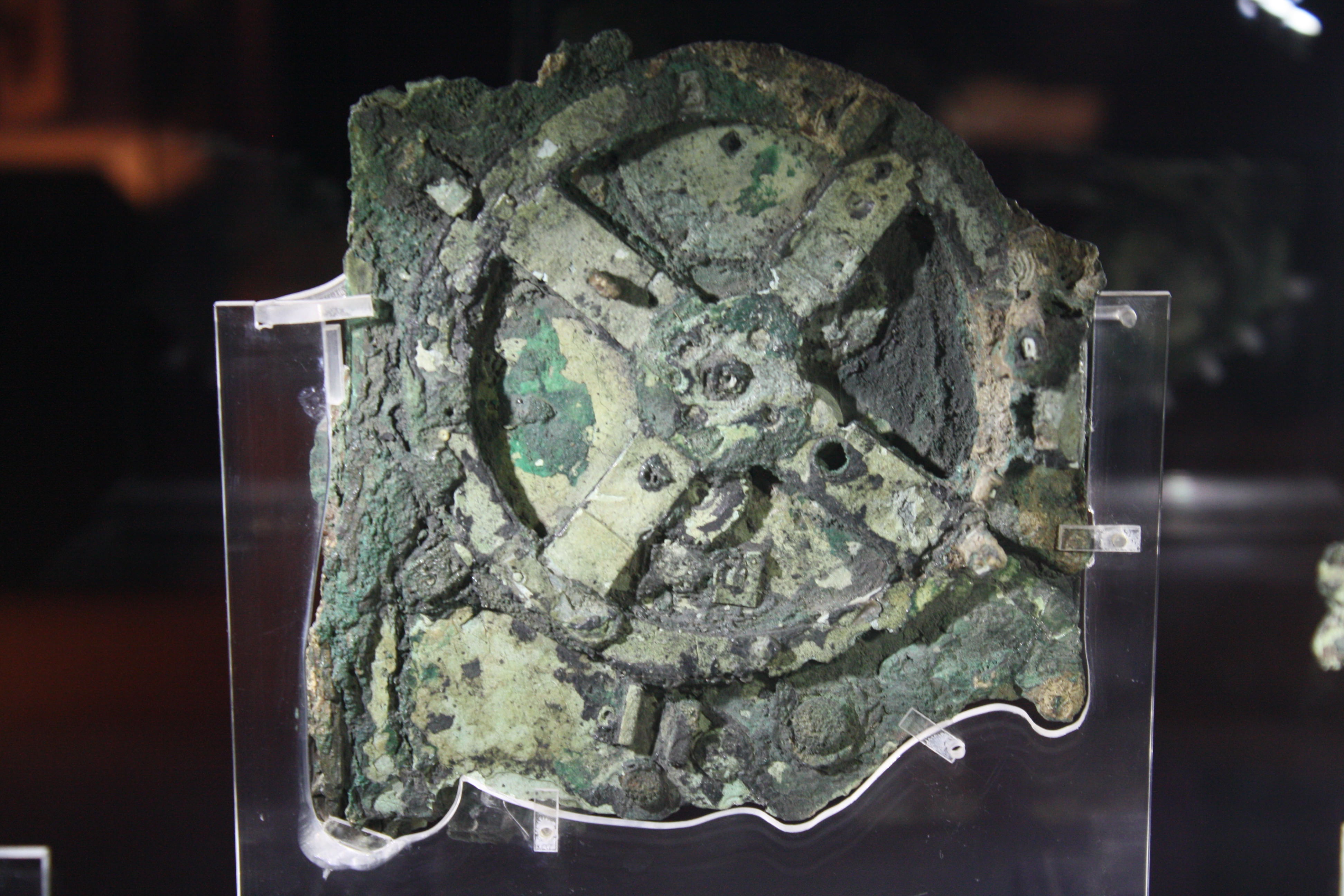
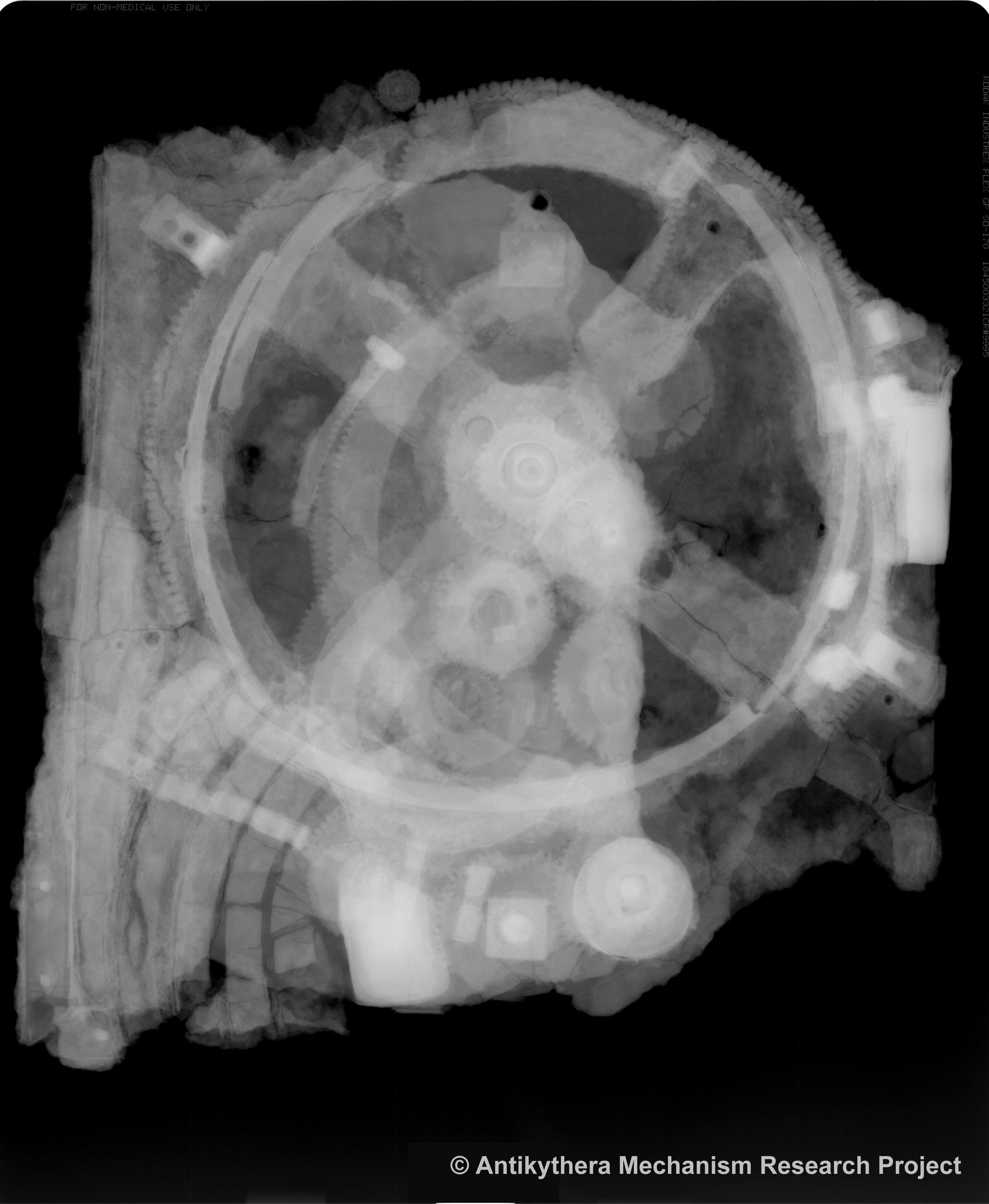
A useful corollary before proceeding: the Antikythera Mechanism was recovered from a Greek shipwreck in 1901 and dismissed for decades as too sophisticated to be what it clearly was. It is now confirmed as a 2,000-year-old analog astronomical computer of extraordinary precision — predating what was then considered the first geared mechanism, the mechanical clock, by more than a thousand years. It does not merely predate the clock. It is categorically more sophisticated: a multi-axis differential gear system computing planetary positions, lunar phases, eclipse cycles, and athletic calendar schedules simultaneously, in a handheld bronze device. The conventional timeline had no framework for it until it was physically in hand and could not be explained away. The lesson is not that ancient people were secretly advanced. It is that the absence of a framework is not evidence of absence, and that when physical evidence contradicts the timeline, the timeline requires revision — not the evidence.
That same principle applies here. Vladimir Yashkardin’s SCIROCCO framework identifies the Great Pyramid of Khufu as a 4 MW vibroacoustic infrasound transmitter operating at a 12.25 Hz carrier frequency, with a global network of engineered receiver sites designed to couple the transmitted signal to human subjects. This is not a fringe claim dressed in technical language — it is a detailed engineering analysis of a physical structure whose geometry, material properties, and dimensional relationships are measurable and documented. The Antikythera Mechanism was not accepted because someone argued persuasively for ancient sophistication. It was accepted because the object itself, examined on its own terms, left no other conclusion available. Yashkardin’s framework asks for the same standard: examine the geometry, account for every feature, and explain what else could require it. Indeed my observations here build off of his framework.
Water appears consistently across these sites in forms that exceed any drinking, agricultural or drainage function. The precision with which it is managed — routed, collected, and directed across dressed stone surfaces — suggests it was integral to how these sites operated. What is conventionally described as ritual use of water may simply be an incomplete description of a more sophisticated function. The article will make that case.
Santa Cristina is analyzed and hypothesized here as a node in that network — an inverted dome receiver whose resonant volume is directed downward into the earth, engineered to receive, amplify, demodulate, and deliver the transmitted signal to a human subject positioned at the convergence of its acoustic pathways. While the acoustic nature of the design is apparent in the geometry, the full scope of its intended use may never be completely understood. Features remain buried, measurements untaken, and connections between sites only partially traced. What is presented here is a rigorous reading of what the physical evidence shows — with the acknowledgment that the most significant implications may still be waiting to be found.
II. Complete Antenna System Architecture
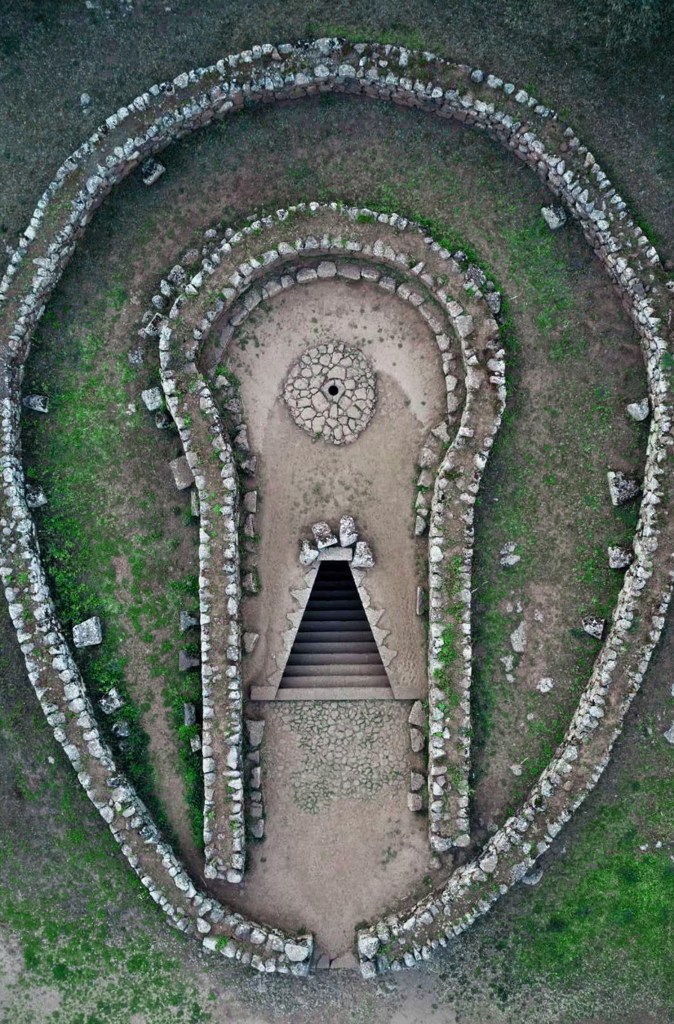
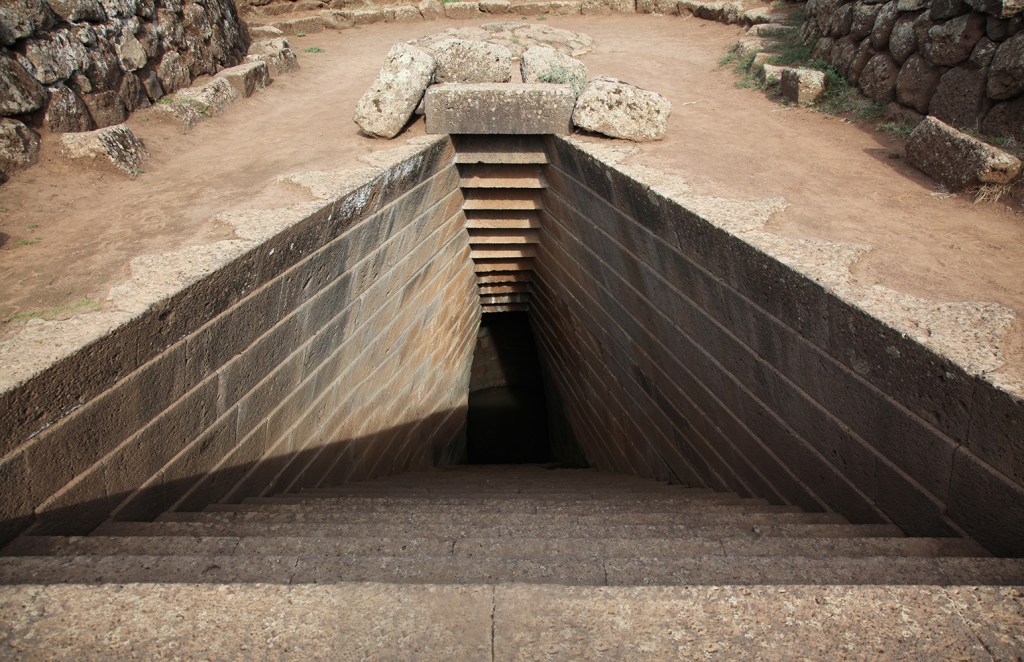
Santa Cristina is not a structure containing an antenna element. It is a complete multi-element antenna receiver system whose every major component corresponds to a documented function in antenna engineering, implemented in stone and geology. The surface Fresnel ring enclosure is the collection aperture. The dromos corridor is the primary directional feed antenna. The stairway is the feed horn. The apex mound and aperture constitute a second independent feed element. The tholos chamber is the resonant load. The Sardinian Craton bedrock is the ground plane — one of the oldest and most seismically stable geological formations in Europe, selected for its efficient long-distance conduction of low-frequency ground waves. Each element performs a documented antenna engineering function. Their simultaneous presence in correct functional sequence from aperture to load is the basis of the antenna interpretation.
2.1 Horizontal Aperture — Ground-Level Signal Intercept
The dromos entrance aperture is horizontal — flush with the ground plane, open to air at the surface, with the signal path descending from ground level into the earth. This is an unusual orientation for a horn antenna. A conventional horn has a vertical aperture face pointing toward a distant source. Santa Cristina’s aperture faces upward into the ground plane, which is precisely correct for intercepting a ground-coupled signal. Infrasound propagating through the Sardinian Craton arrives as a solid-borne wave from below and laterally — not as an airborne signal from a point source above the horizon. The horizontal aperture intercepts the field concentrated by the surface Fresnel ring system across its full collection footprint and directs it downward into the stairway horn below. The signal path is: surface collection → horizontal aperture → descending trapezoidal waveguide → curved throat transition → tholos resonant load.
2.2 Dromos — Directional Feed, Matching Network, and Transduction
The dromos performs the most explicit matching function in the transduction chain. Its dressed stone wall slabs are the first active transduction surfaces — each slab mechanically continuous with bedrock on its outer face and exposed to the air column on its inner face, functioning as a panel transducer whose dimensions encode a preferred transduction frequency. The dromos length is an electrical matching section. Its entrance geometry defines the aperture impedance of the structure as seen from the incoming ground wave.
Stone elements insertable at specific positions along the dromos — documented at sites with confirmed sliding portcullis slots in Giza and comparable Nile valley sites — would change the local impedance of the matching network at that point, shifting the matched frequency or improving bandwidth. What has been described in some archaeological literature as a portcullis threshold at Nuragic sacred wells is the terminal ceiling corbel stone — the final inward-projecting course of the stairway ceiling, forming the fixed rectangular aperture that transitions the stairway throat into the circular tholos volume. This is a fixed structural element, not a removable or adjustable one. The impedance matching function at this junction is performed by the geometry of the curved wall transition itself, not by an insertable stone element.
The dromos is oriented approximately 100–120° from north, consistent with the refraction-corrected bearing from Sardinia to Giza. Ground-coupled infrasound refracts through the Apennine subduction zone, Tyrrhenian basin sediments, and Sardinian Craton basement — each geological boundary bending the wavefront. The dromos is oriented to the actual wavefront arrival angle after this geological refraction. This is a testable prediction: seismological modeling of 12.25 Hz propagation from Giza through the published Mediterranean geological model should yield a wavefront arrival angle at Santa Cristina within ±5° of the measured dromos bearing.
The geometry transitions in two distinct stages. The dromos is trapezoidal in cross-section — 3.47m wide at the aperture, narrowing to 1.40m at the throat, with straight walls maintaining consistent reflection geometry along the full approach length. At the junction with the tholos, the straight trapezoidal walls curve inward — a matched transition section transforming the rectangular waveguide mode of the dromos into the circular resonant modes of the tholos. A hard rectangular-to-circular junction would cause significant reflection loss. The curved transition distributes the geometric change over a spatial length, minimizing reflection and maximizing energy transfer into the resonant load..
2.3 Scale Invariance — The Stepped Horn Principle
The physics governing a stepped horn antenna is described entirely in terms of ratios — the relationship between step dimensions, horn aperture, throat width, and the wavelength of the target frequency. There are no absolute dimensions in the governing equations. A stepped horn designed for 24 GHz microwave and one designed for 12.25 Hz infrasound follow identical geometric relationships — the infrasound version scaled up by approximately two billion in linear dimension. The physics does not change. Zhang et al. (2018, Applied Sciences, doi: 10.3390/app8010033) document a ridged horn geometry at microwave frequencies — longitudinal fins running parallel to the direction of propagation. Santa Cristina implements a stepped horn geometry — discrete cross-section reductions perpendicular to the direction of propagation at each course interval. These are distinct implementations: the ridged horn loads the cross-section continuously along the horn length; the stepped horn creates discrete impedance discontinuities at each step. Both support sub-wavelength TEM mode propagation through related mechanisms. The Zhang citation is valid for the propagation principle and the scale invariance of the governing ratios — not as a direct geometric equivalent.
2.4 Apex Mound — Ground-Level Concentrating Dish
The apex mound at ground level surrounding the 35cm aperture is a dished concave surface — an arc rotated around the central axis, 3.515m in diameter, with a shallow long-focal-length geometry. This is not a simple aperture surround. It is a ground-level concentrating dish: a third collection element at the site alongside the Fresnel ring enclosure and the dromos aperture, each operating at a different scale and collecting energy from a different footprint. The dished surface intercepts incoming energy across the full 3.515m diameter and concentrates it toward a focal point above the center before directing it downward through the 35cm neck — a collection area ratio of approximately 100:1 relative to the aperture alone. The shallow dish geometry produces a long focal length — convergence occurs above the aperture surface rather than at it, pre-focusing the collected field before it enters the neck.
The mound construction is loose stones with soil matrix rather than the precision dressed basalt of the subterranean structure. This distinction may be functional rather than expedient — a compliant surface of loose stones in soil matrix presents a specific acoustic impedance that provides a more gradual transition between the hard geological medium and the air column below than a rigid stone surface would. The loose construction is a candidate impedance matching layer at the surface collection stage.
The effective neck length — the constrained 35cm aperture path from dish surface to tholos interior — is substantially longer than the 26.8cm above-ground mound height alone suggests. Based on the site reconstruction model, the total neck length including the below-grade stone depth is estimated at approximately 0.8–1.3m. The precise figure requires on-site measurement and is noted as a priority for the planned site visit.
2.5 Mechanical Transduction Chain
The arriving signal is a solid-borne mechanical wave propagating through the Sardinian Craton at approximately 3,000–6,000 m/s — in a medium whose acoustic impedance is roughly 40,000 times higher than air. A direct rock-to-air boundary transfers less than 0.01% of incident energy. The complete structure is the solution to this impedance mismatch — every element is a stage in the transduction chain from solid ground wave to air column standing wave. Dromos wall panel transducers perform the first solid-to-air conversion. Corbelled ledge cantilevers throughout the stairway and tholos contribute as distributed mechanical resonators, each at its own flexural resonant frequency, creating a graduated broadband transducer array shaped by the course geometry. Stone inserts at calculated positions act as impedance matching elements — presenting intermediate impedance between wall and air column, improving energy transfer at the carrier frequency.
2.6 Surface Architecture
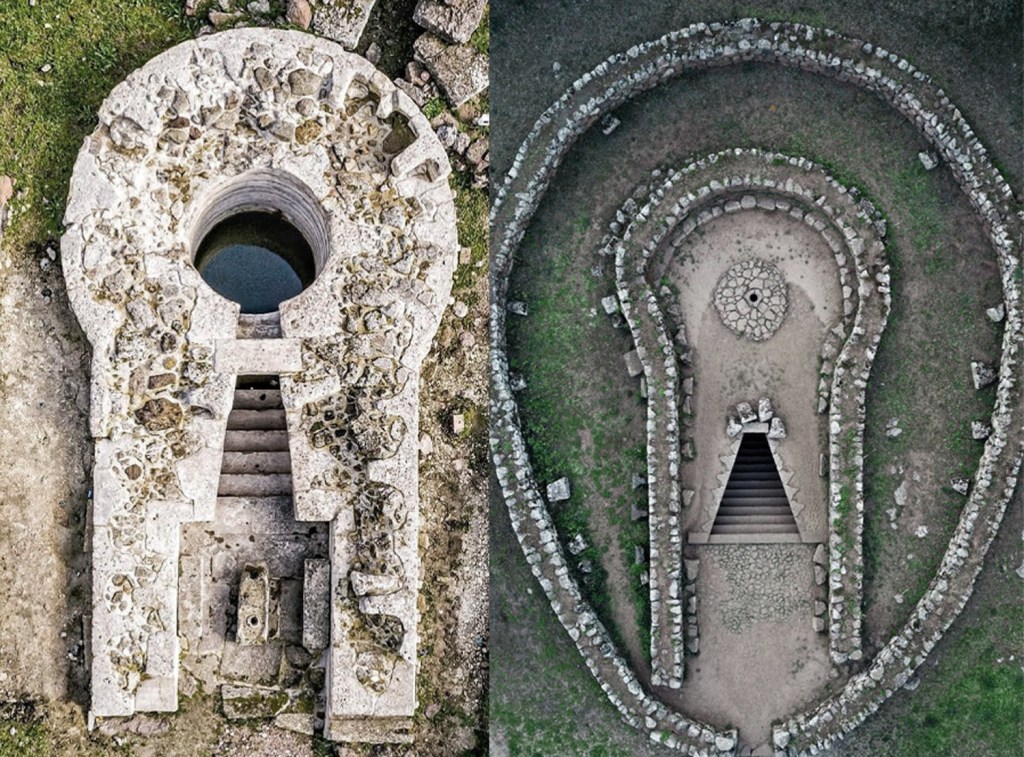
The current above-grade surface condition at Santa Cristina almost certainly does not represent the original construction. The visible ring enclosure walls have the character of reorganized rather than originally placed stone — courses are inconsistent, placement is irregular, and the overall form lacks the precision evident throughout the subterranean structure. Triangular dressed stones lying displaced on the surface adjacent to the enclosure walls are inconsistent with the rubble construction and suggest a more precisely engineered original surface geometry whose elements have been scattered, removed, or partially dismantled over three millennia of surface exposure, agricultural activity, and stone robbing.
A comparative reference is available. Predio Canopoli, a Nuragic sacred well of the same type and period, preserves a more complete above-grade surface treatment: a consolidated mortared rubble apron covering the full forecourt and wrapping the tholos crown as a unified horizontal surface, with precision-cut portcullis receiver slots visible at the dromos threshold jambs. If Santa Cristina’s original surface architecture was similarly unified and consolidated — as the displaced triangular dressed stones suggest it may have been — the acoustic implications are significant. A rigid continuous apron mechanically coupled to the subterranean structure transmits ground-coupled vibration across its full surface footprint into the structure below. The original surface treatment was not merely protective. It was acoustically active. The surface collection system’s original performance cannot be evaluated from the current surface condition, and the triangular displaced stones are the most direct physical evidence that a more sophisticated original geometry existed.
III. The Stairway – Stepped Converging Horn
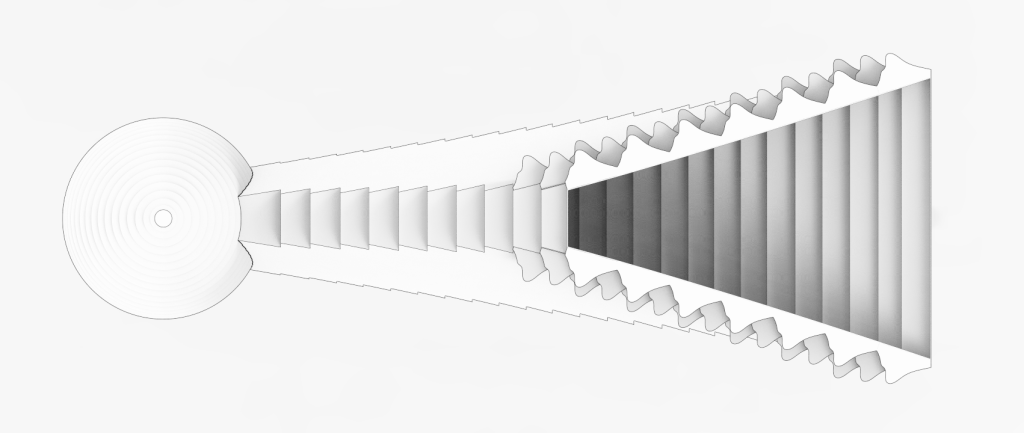
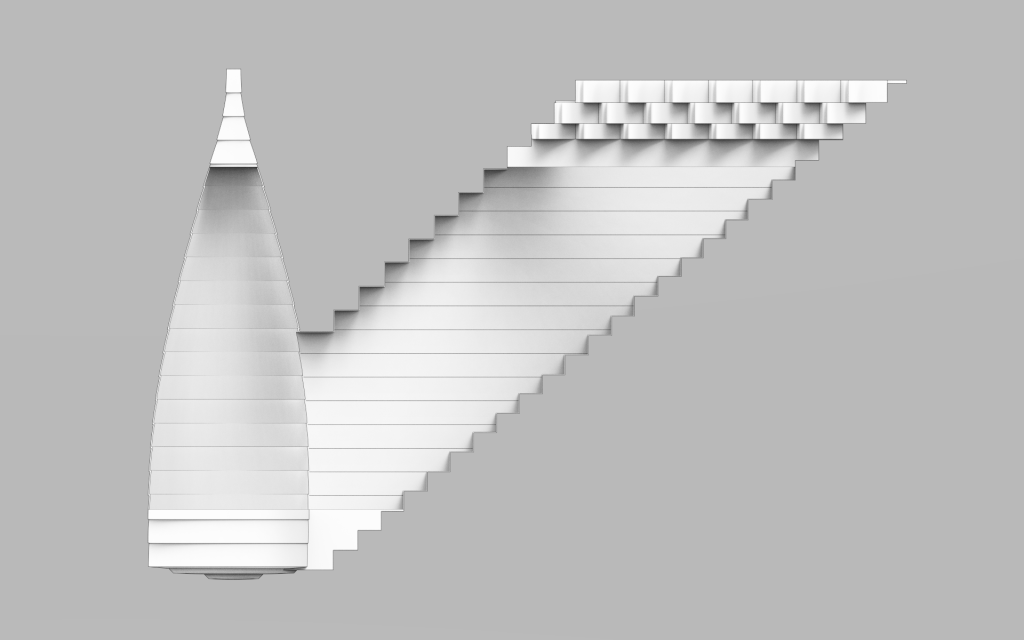
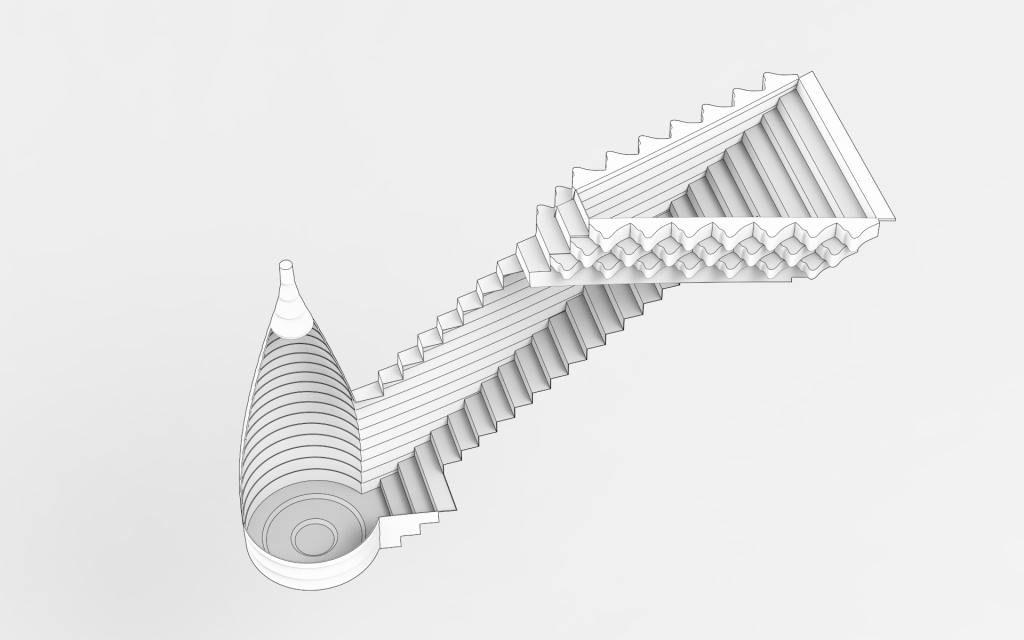
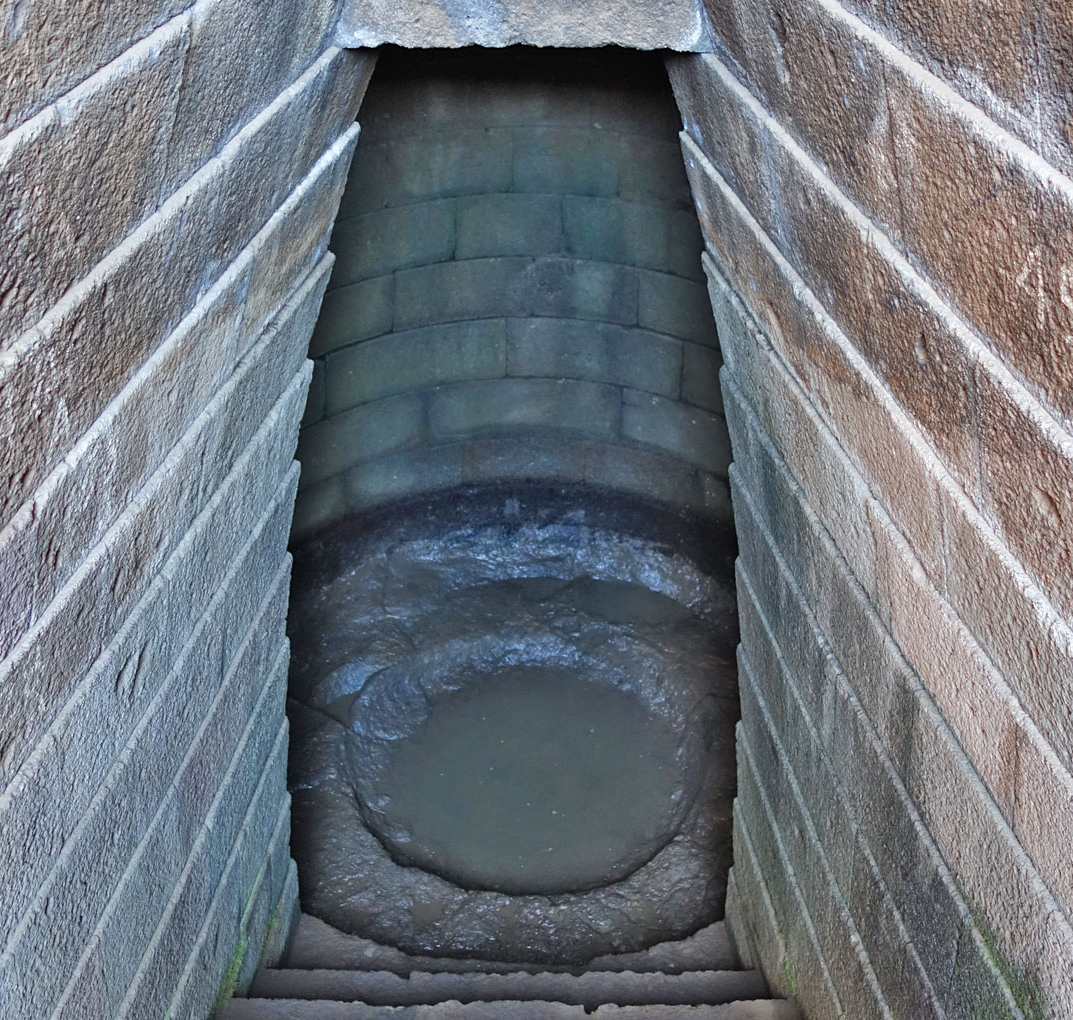
The ceiling corbels, sidewall corbels, stair treads, and tholos rings are all the same continuous horizontal stone courses, running uninterrupted from the dromos throat to the tholos apex. The step underfoot, the ledge beside you, the projection overhead, and the tholos ring at the same depth are the same stone course expressed on four surfaces simultaneously. Every acoustic function described below follows from this single geometric decision: the course spacing, chosen once at design stage and executed throughout.
3.1 Geometric Horn — Pressure Amplification
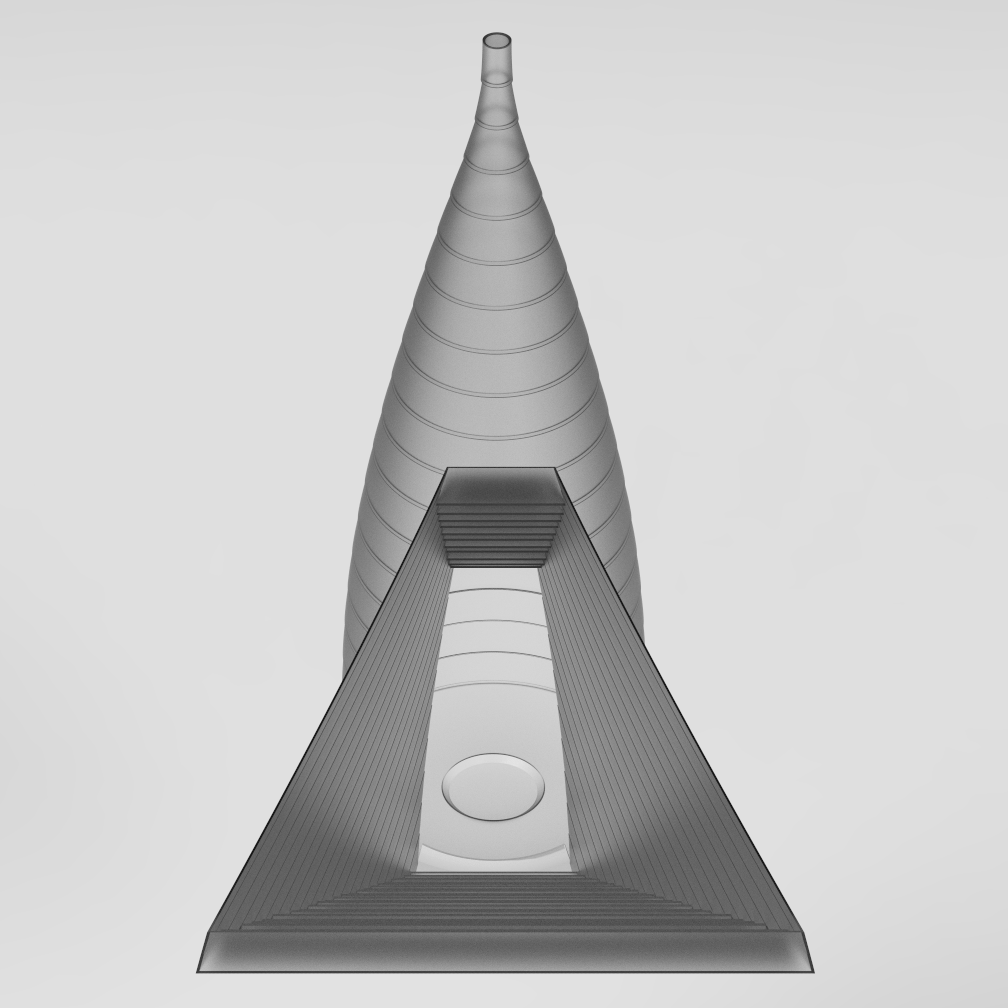
The stairway cross-section narrows continuously from the dromos throat to the tholos entrance. Measured dimensions: 3.47m wide at the aperture, 1.40m at the throat — a 2.48:1 linear dimension reduction. Because ceiling and sidewall corbels share the same unified course geometry, both width and height reduce simultaneously — a fully three-dimensional taper. The area ratio is approximately 6:1, producing a pressure amplification of roughly 15.6 dB from geometry alone, before any resonant effects.
3.2 Stepped Horn Geometry — Sub-Wavelength Carrier Transmission
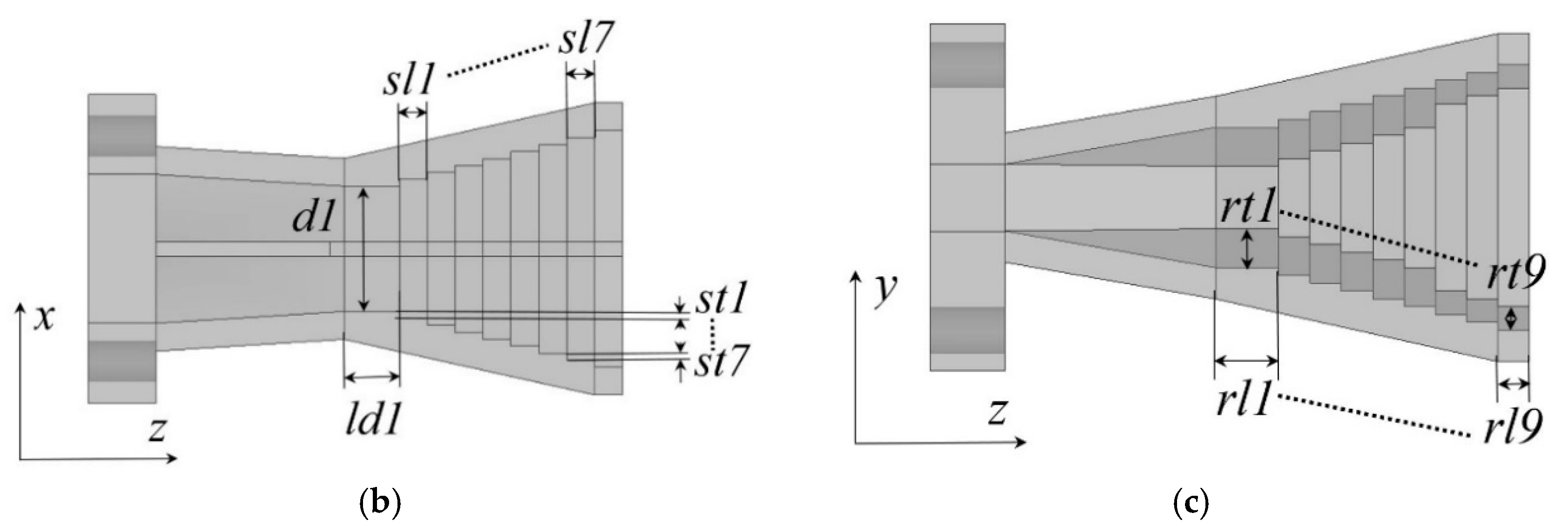
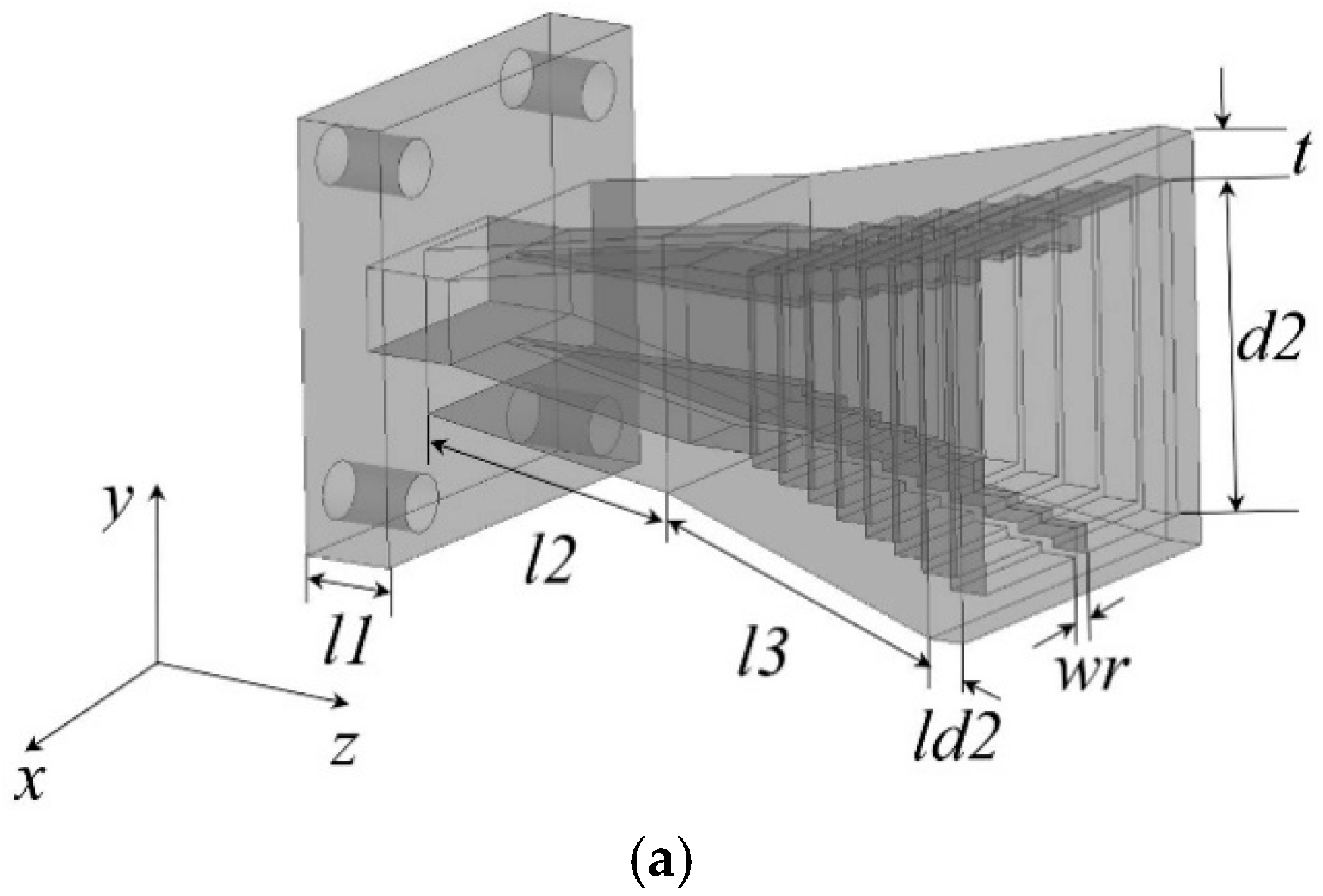 Example shown of K-Band-Stepped, Double-Ridged Square Horn Antennas incorporating the “steps” and corbeled walls as seen in Santa Cristina.
The corbelled course ledges — upward-facing horizontal projections on both walls throughout the passage length — constitute a stepped horn geometry. Each course creates a discrete cross-section reduction perpendicular to the direction of propagation, producing periodic impedance discontinuities at each step interval. The TEM mode supported by this stepped geometry has zero cutoff frequency and propagates regardless of cross-section dimensions relative to wavelength. At 12.25 Hz the stairway dimensions are sub-wavelength (d/λ ≈ 0.25–0.3) — too small to support conventional horn modes. The stepped horn geometry enables carrier transmission through the TEM mode precisely because no minimum frequency requirement exists for that mode. This is the primary mechanism enabling carrier propagation through a structure whose physical dimensions are sub-wavelength at 12.25 Hz.
3.3 Dual Cascade Frequencies — Two-Channel Harmonic Amplification
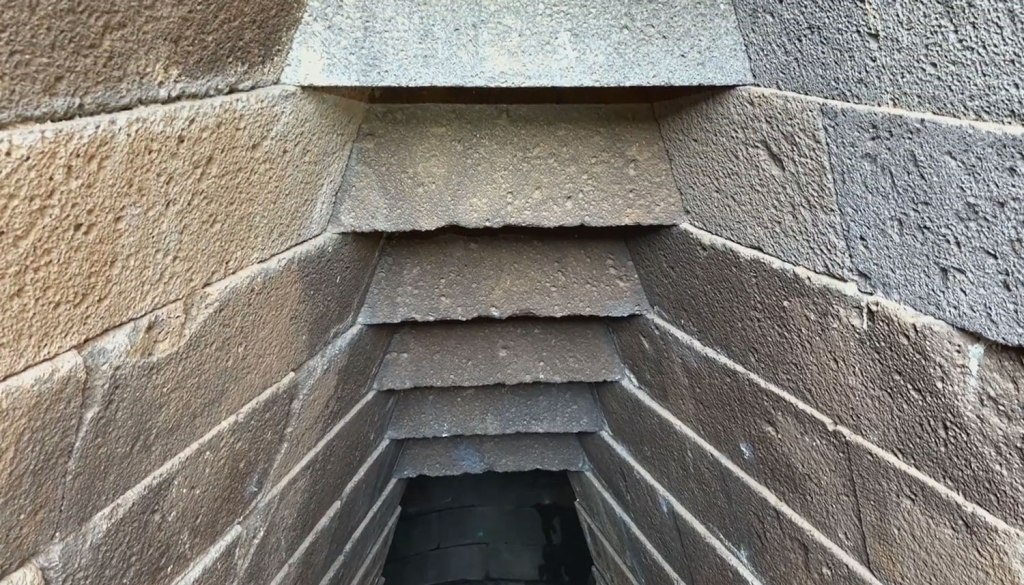
The stairway has 25 floor steps and 12 ceiling steps over an 11-meter slope length. These are not the same course spacing expressed on two surfaces — they are two distinct periodic geometries operating simultaneously in the same waveguide, producing two distinct constructive interference conditions.
Floor step spacing: 11m / 25 = 0.44m. Constructive interference at λ/2: target frequency = 343 / 0.88 = 390 Hz.
Ceiling step spacing: 11m / 12 = 0.917m. Constructive interference at λ/2: target frequency = 343 / 1.834 = 187 Hz.
187 Hz and 390 Hz are approximately one octave apart — a musically coherent relationship, both within the audible harmonic delivery range of the system. Neither is the carrier frequency. The stepped horn TEM mode handles sub-wavelength carrier transmission; the dual cascade geometry provides coherent amplification at two distinct harmonic frequencies simultaneously. 187 Hz is in proximity to the 196 Hz Framework Stone harmonic; 390 Hz approaches the 4th harmonic of 98 Hz. These are candidate alignments pending precise stairway length measurement on site.
A person descending is in solid contact with the corrugated floor from the first step. Bone-conduction coupling of the full composite signal into the skeleton begins at the entrance — before any vestibular or auditory effects engage. Descent progressively adds each coupling pathway: feet first, then lateral vestibular, then overhead ceiling — building toward maximum whole-body coupling at the tholos throat.
Three resonant modes, three geometric features, three neurological targets 2.5–3.2 Hz delta band (apex aperture Helmholtz), 12.25 Hz carrier exact (7m chamber height), 187 Hz and 390 Hz audible harmonics (dual stairway cascade). Each encoded independently. Each serving a distinct function in the signal chain.
3.4 Three-Layer Surface Architecture
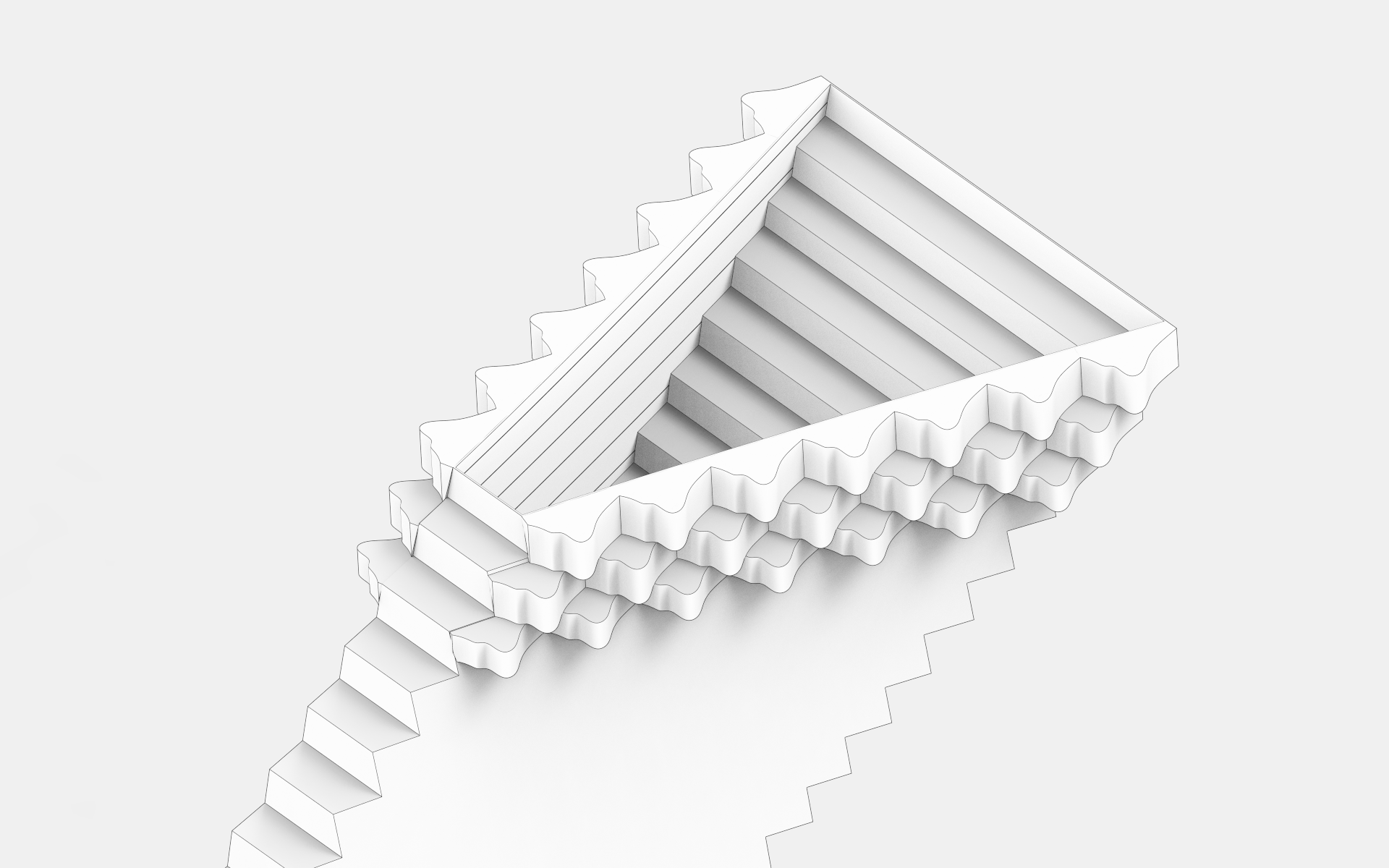
The stone courses present three distinct surface geometries on three faces of the same stones, operating in three separate acoustic domains. The outer buried faces — the exterior of the structure, interfacing with surrounding earth and bedrock, not visible from inside — present triangular or pyramidal profiles constituting a blazed reflection grating at the structure-bedrock interface. These exterior profiles convert normally-incident ground waves into guided modes coupling into the structure from outside. This capture stage is entirely buried. The upward-facing course ledges — the corbelled horizontal projections forming the stair treads underfoot and the ceiling steps overhead — are the stepped transmission geometry enabling sub-wavelength carrier propagation via TEM mode and driving the dual cascade amplification. The interior stone faces, visible from within the stairway air column, present the upward-facing ledge edges at each course boundary on the sidewalls, and the full stepped tread and riser geometry on ceiling and floor. The sidewall interior face contribution is a weaker periodic feature than the ceiling and floor; whether it is sufficient to produce mode-filtering effects at upper harmonics depends on ledge projection depth relative to wavelength and has not been confirmed from available documentation.
3.5 Grand Gallery Parallel
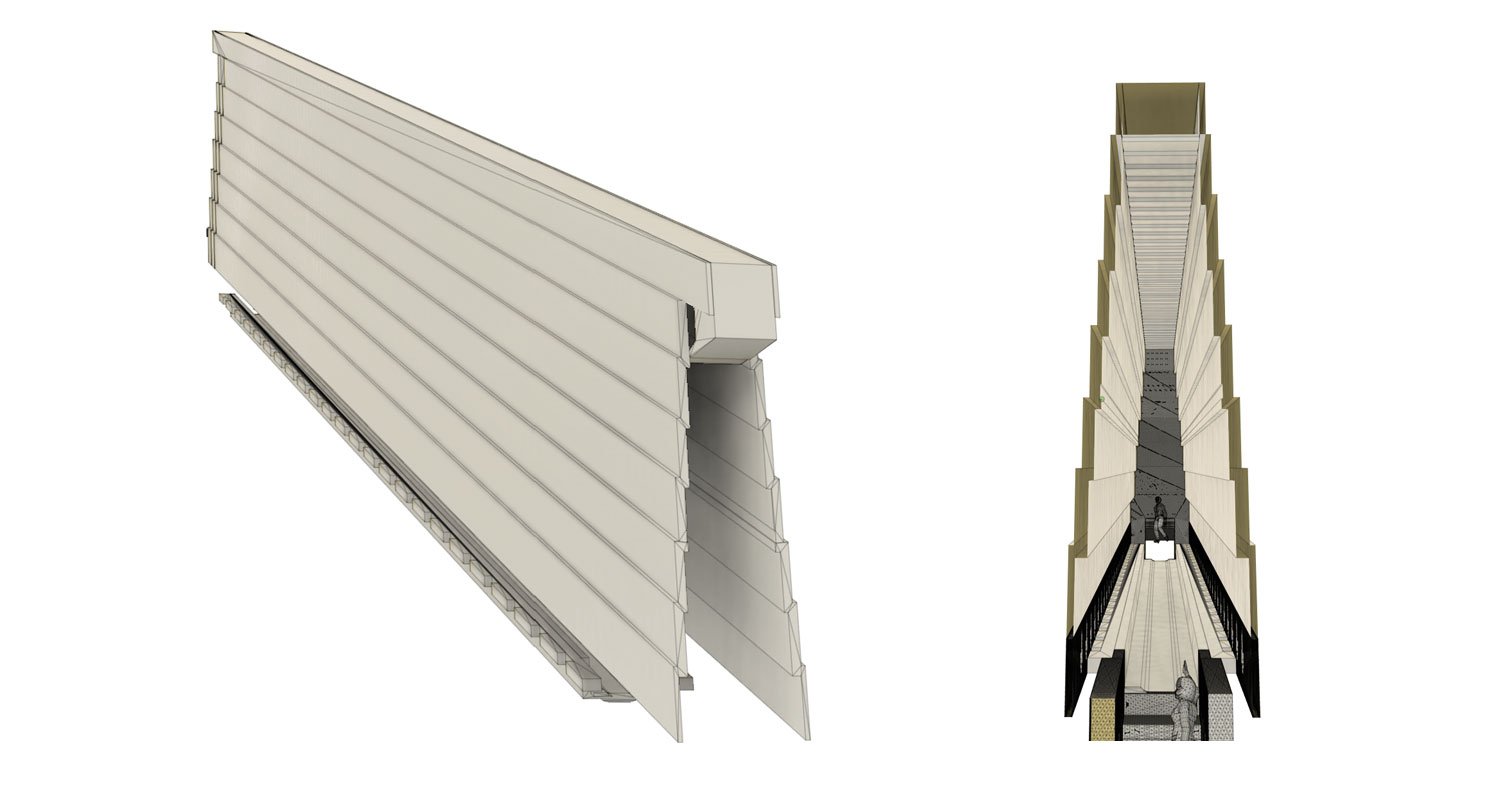
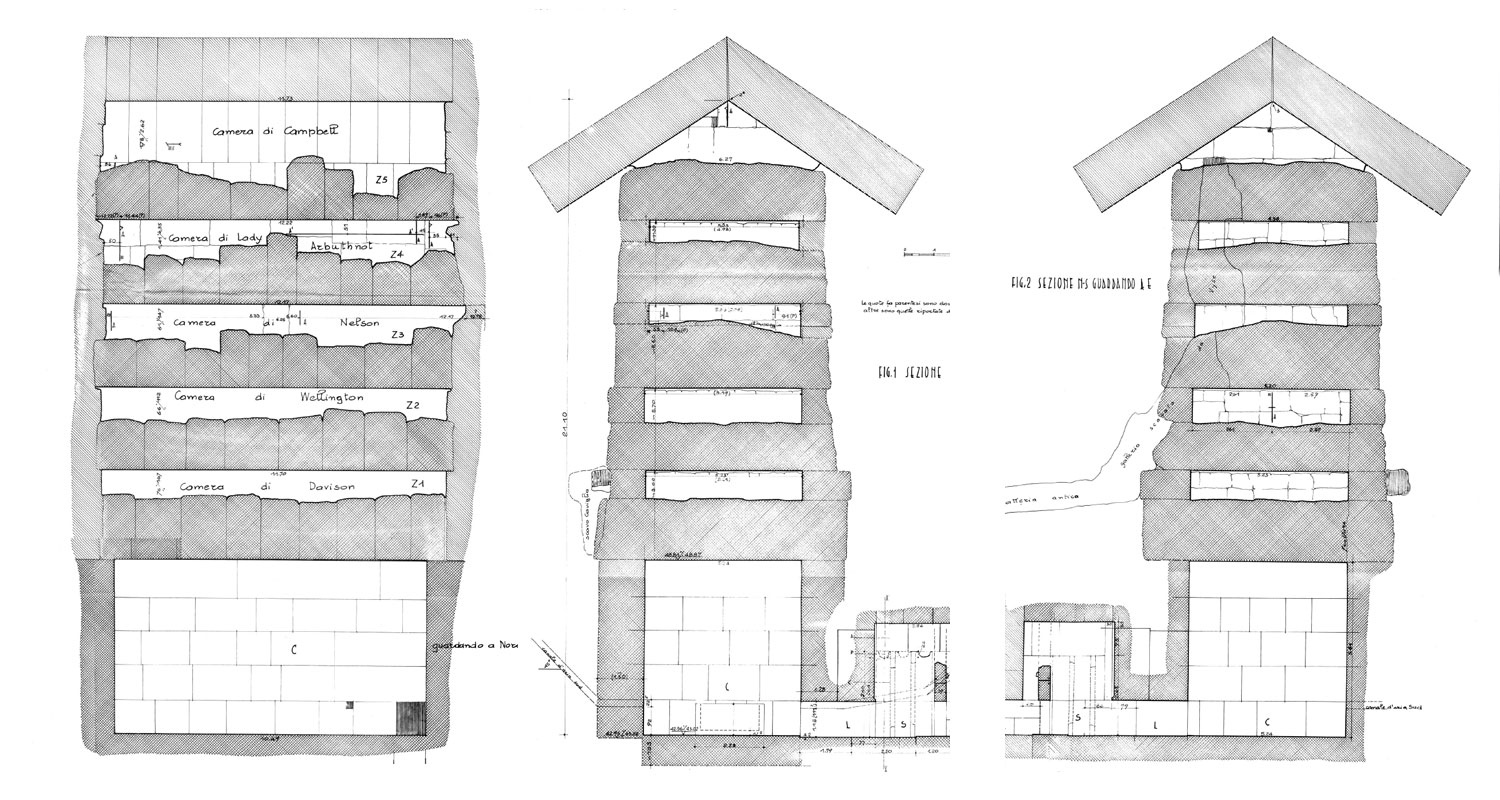
The Grand Gallery of the Great Pyramid shares identical trapezoidal cross-section geometry: narrow at the top, wide at the bottom, with upward-facing corbelled ledges along the full passage length. The Grand Gallery ascends toward its narrow end, terminating above at the King’s Chamber granite resonant box. The Santa Cristina stairway descends from its narrow upper entrance, terminating below at the tholos water-terminated cavity. Direction of travel is opposite; geometry is the same. At the system level: the Grand Gallery is one amplification component within a larger transmitter. Santa Cristina implements the entire receiver chain — collection aperture, directional feed, feed horn, resonant load, and geological ground plane — within a single site.
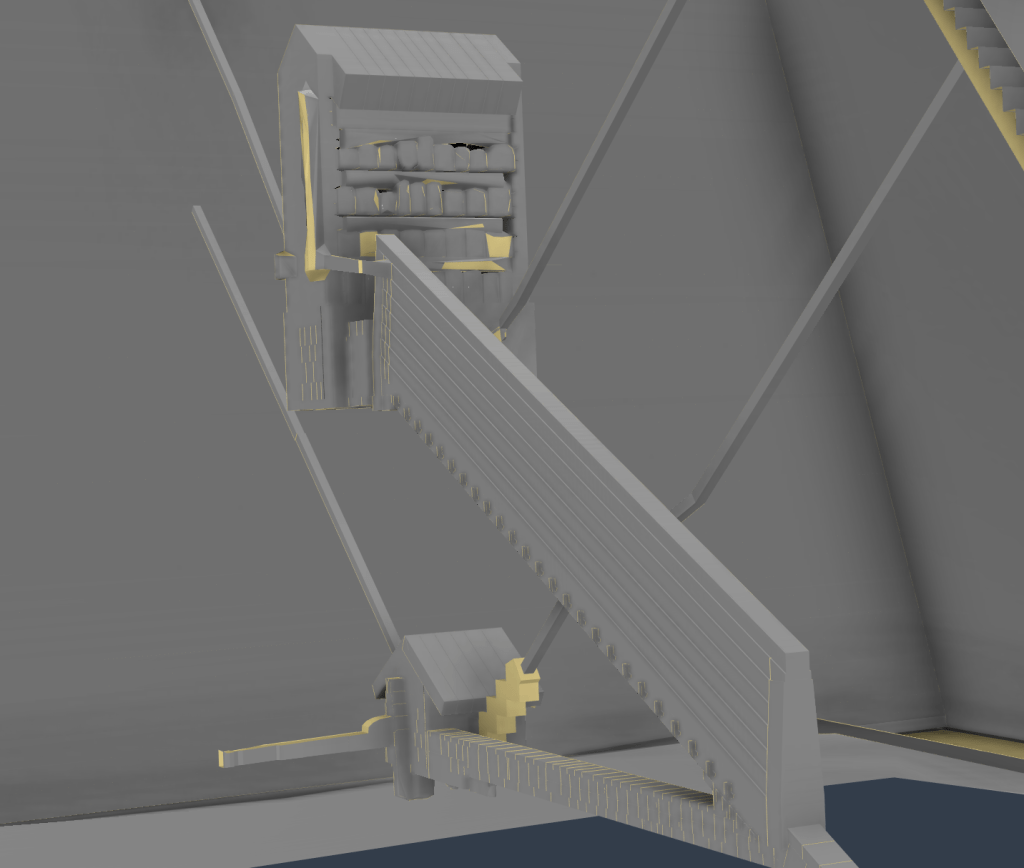
3.6 Site Reconstruction Model
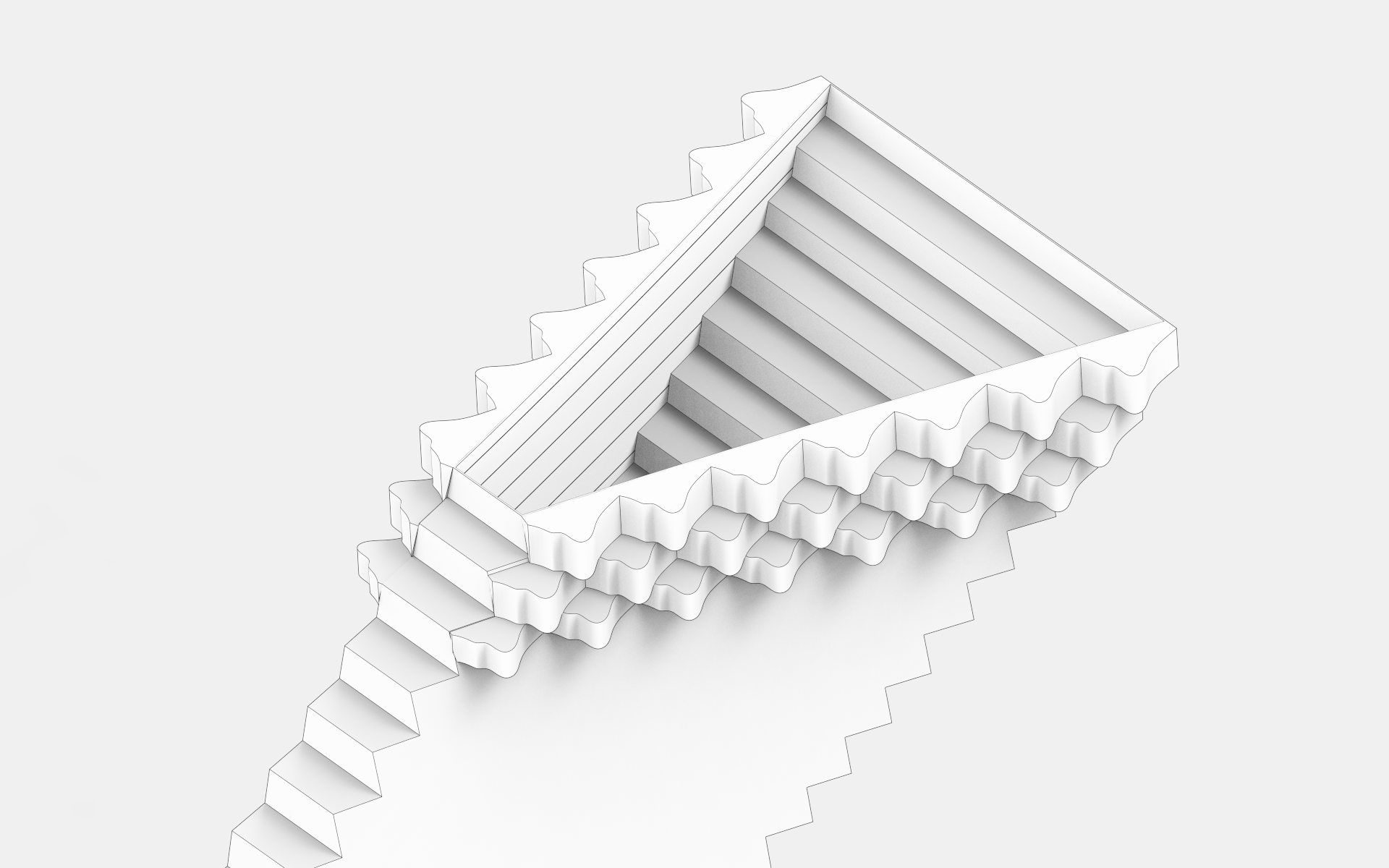
I created a CAD reconstruction of the complete site from available dimensional data and an iPhone photogrammetric scan. The model confirms the general geometry and relative proportions: teardrop tholos profile, dished apex mound with narrow neck, stairway descent angle of approximately 30–35 degrees, and the floor/ceiling step count asymmetry. It is presented as a working visualization tool. Precise dimensional data awaits a planned on-site measurement survey using laser distance measurement and calibrated photogrammetry.
IV. Potential Design Intent of Triangle-Shaped Stones
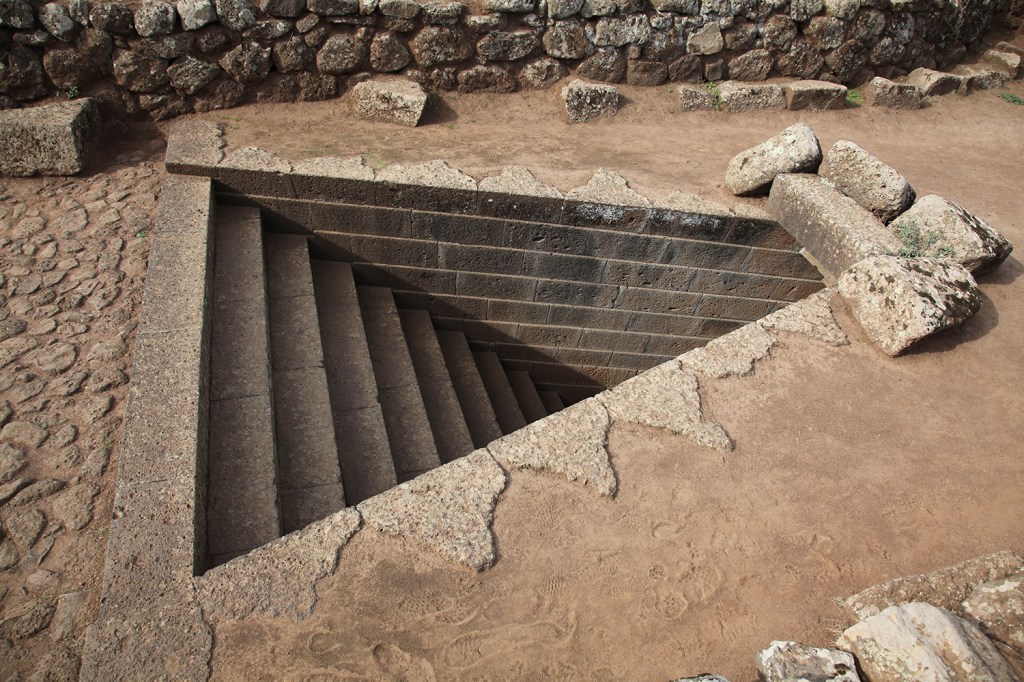
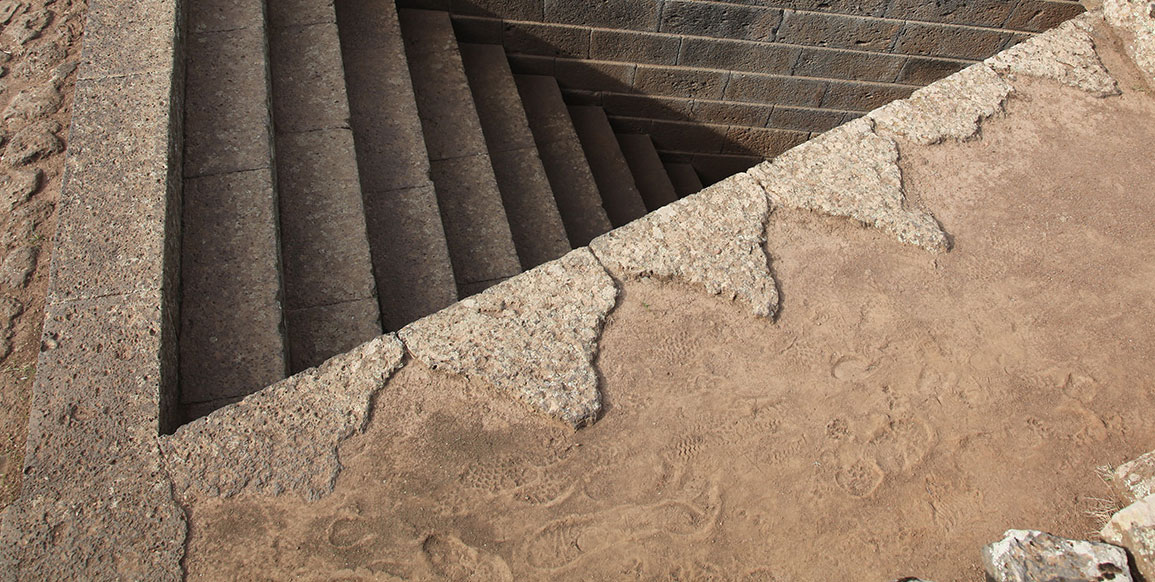
Aerial photography of Santa Cristina reveals that the exposed capstones of both the dromos walls and the tholos enclosure wall terminate in triangular or wedge-shaped apices rather than flat surfaces, producing a continuous sawtooth profile around the entire structure perimeter at ground level. This is consistent across all exposed wall-top stones in both the linear dromos walls and the curved tholos enclosure.
Whether the triangular profile is limited to the exposed aperture-edge stones or continues uniformly throughout the full depth of the subterranean structure cannot be confirmed without disassembly. Both cases carry distinct acoustic implications addressed below.
4.1 Pre-restoration State — Santa Cristina, late 19th century
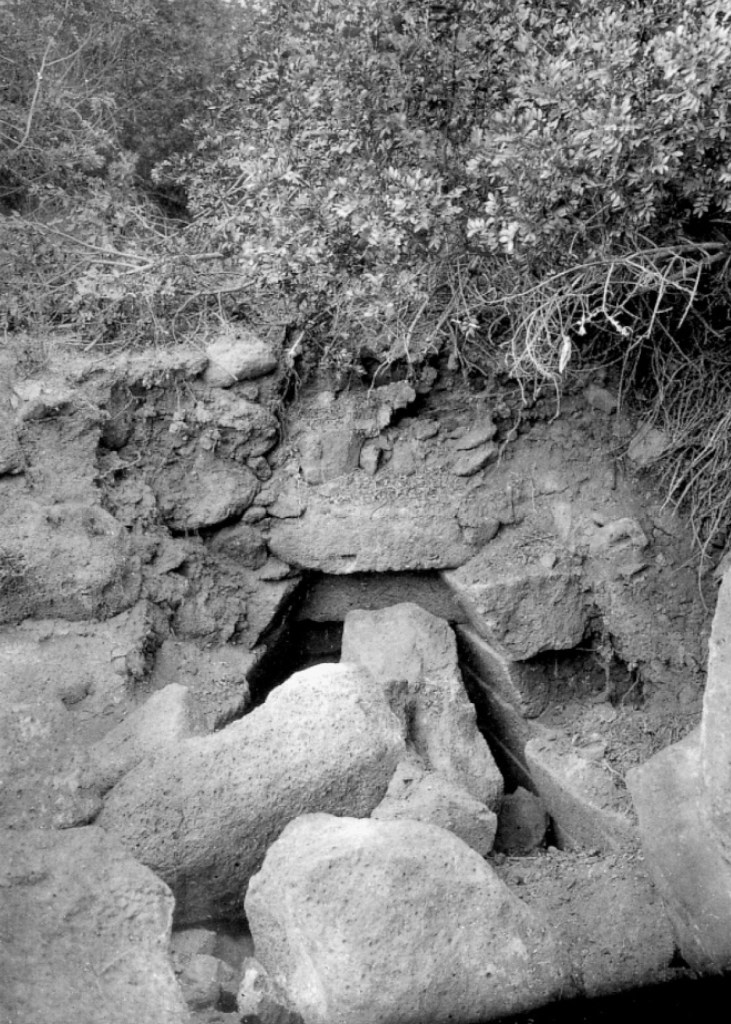
The earliest known photograph of the site, dating to the late 1800s, shows the structure substantially buried under compacted fill and displaced rubble, with upper wall courses only partially visible through the overburden. Vegetation had rooted deeply into the fill, indicating it had been stable for a significant period before the photograph was taken. The surrounding displaced stones — large, irregular, and not in any coursed arrangement — are inconsistent with gradual sediment accumulation. The pattern is more consistent with a single high-energy depositional event: a violent overburden that buried the structure and threw large blocks clear of their original positions.
This has two implications for the triangular stone analysis. First, the triangular capstone profiles documented in modern aerial photography were revealed during excavation and restoration rather than continuously exposed — their current arrangement reflects the restoration process, and whether that process accurately reconstructed the original capstone configuration cannot be independently verified from the photographic record alone. Second, if the surface architecture was subjected to a high-energy destructive event, the survival of the triangular profiles through the stairway depth becomes more significant: the subterranean courses were protected by the very earth fill that obscured them, preserving whatever profile geometry was used throughout the wall construction.
Buried by violence, preserved by burial The pre-restoration photograph shows chaotic overburden inconsistent with gradual silting. The subterranean wall courses — protected by the same fill that obscured the site — may preserve the original triangular profile geometry intact throughout their full depth. The destruction that buried Santa Cristina may be the reason the acoustic geometry survived.
4.2 Comparative Note — Predio Canopoli
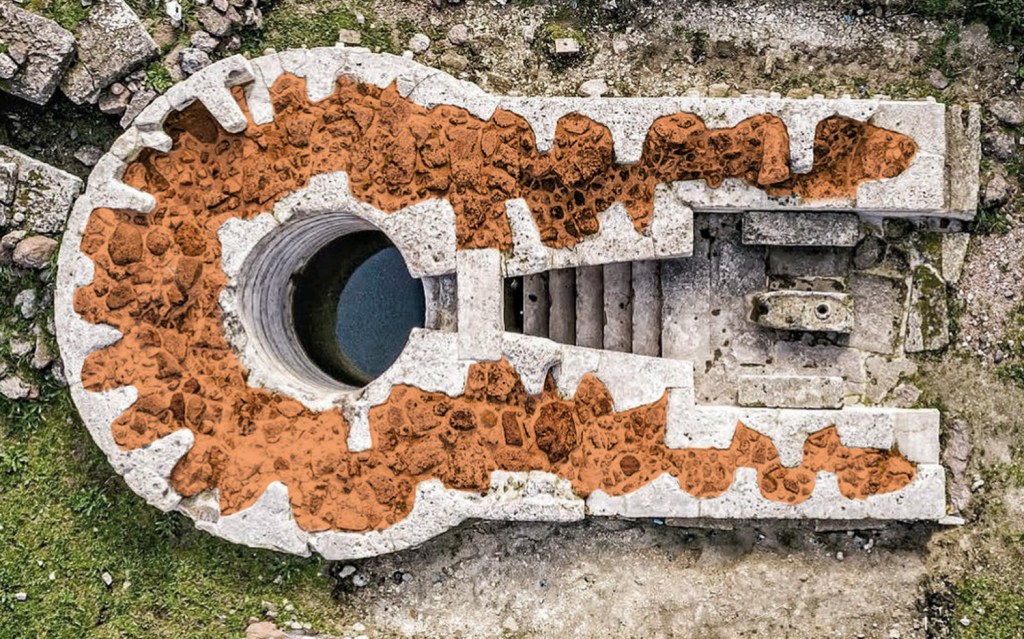
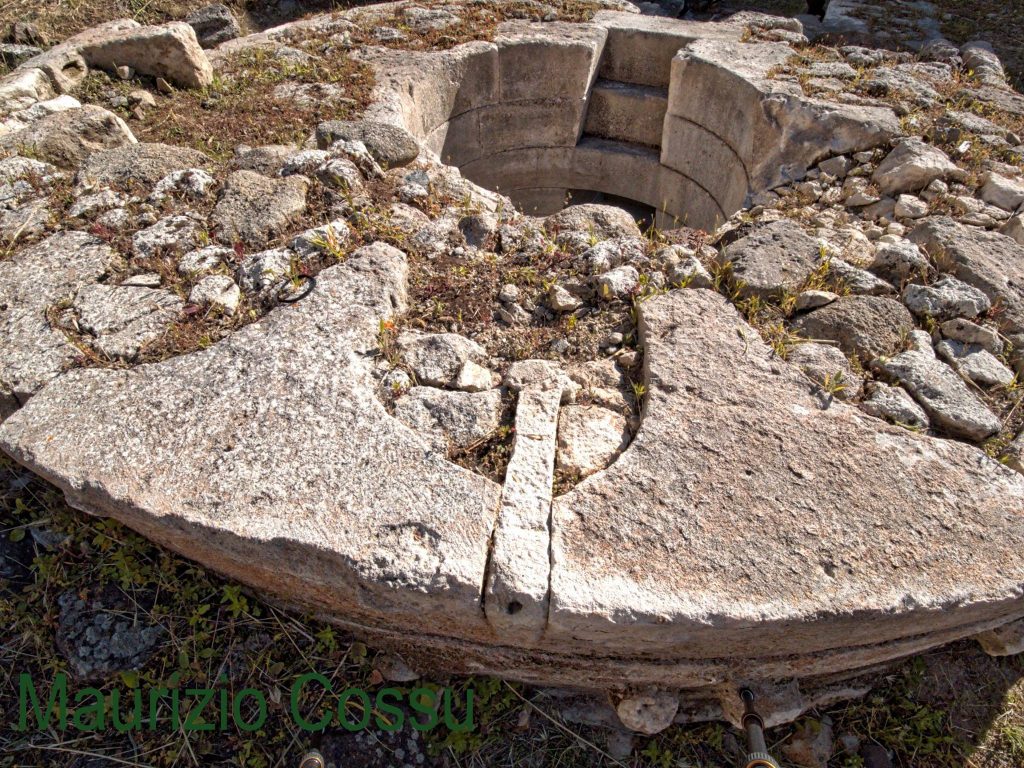
Ground-level photography of the nearby Nuragic sacred well at Predio Canopoli reveals triangular-profiled stones in its wall construction — and critically, where an upper stone is displaced or partially removed, the course beneath it shows the same triangular profile. The triangular geometry therefore extends through at least two visible courses, suggesting it is not a capstone-only surface treatment but a consistent profile carried through the wall depth. This appears to be a shared Nuragic construction technique rather than a feature unique to Santa Cristina.
This reframes the interpretive question. The relevant distinction is no longer whether triangular profiles were intentional — they clearly were, at multiple sites — but whether their acoustic consequences were understood and deliberately exploited. Santa Cristina’s builders had access to the same construction tradition as Predio Canopoli. If triangular-profiled wall construction was standard Nuragic practice, builders across multiple generations of sacred well construction would have accumulated direct empirical experience of how these structures behaved acoustically. Santa Cristina’s geometry — the most fully developed example of the type — would then represent the most optimized application of a technique whose acoustic properties were known from practice, not discovered accidentally.
Predio Canopoli also confirms the concentric tholos floor ring geometry as a shared Nuragic type feature, and provides the clearest available photograph of the dromos rectangular throat opening into the circular tholos volume — the antenna geometry made visually explicit from below.
4.3 Construction Economy
A triangular profile removes less material than a fully rectangular block and creates natural voids that rubble fill keys into without precise packing. In principle this represents a minor labor reduction. However, producing a consistent triangular apex across every capstone in basalt — which does not cleave to convenient angles — requires controlled shaping work comparable to or exceeding that needed for flat tops. Its absence at structurally comparable contemporary sites further weakens economy as a primary driver.
One profile decision. Three potential functions. Structural locking. Acoustic surface wave suppression. Possible waveguide conditioning throughout full horn depth. Economy of explanation does not account for the specificity of the geometry or its absence elsewhere.
4.4 Mechanical Earth Interlock
The wedge geometry of each capstone converts lateral soil pressure into compressive bearing against surrounding fill — the harder the lateral force, the more the triangular apex locks into packed earth. This preserves the dimensional precision of the dromos horn geometry under centuries of soil loading without mortar. The structural locking argument is strongest at the aperture edge where earth fill provides confinement; it weakens deeper where surrounding bedrock takes over that role.
4.5 Corrugated Horn Aperture
In RF antenna engineering, periodic impedance discontinuities at a horn aperture edge suppress surface wave back-propagation that degrades beam integrity — the standard corrugated horn solution. The triangular stone profiles appear precisely at the aperture transition between the subterranean guided acoustic field and the open dromos platform. For the site’s secondary resonator frequencies (34–196 Hz, wavelengths ~1.7–10 m), stone tooth spacing of approximately 0.3–0.8 m produces reactive surface conditions consistent with corrugated aperture engineering. The analogy is drawn across frequency regimes; the mechanism is directionally applicable but requires scaling adjustment for quantitative transfer.
Corrugated horn aperture — aperture edge only Triangular tooth spacing ~0.3–0.8 m. Target frequencies 34–196 Hz. Periodic impedance discontinuities at stairway-to-dromos transition suppress surface wave back-propagation, maintaining beam coherence at the horn mouth.
4.6 Corrugated Waveguide — Exterior Profile, Interior Geometry
The triangular profiles documented on the exposed surface level stones for the passage are exterior features — the outer faces of the wall stones, buried in earth and interfacing with the surrounding geological medium, not the acoustic air column inside the stairway. Their primary acoustic function is the blazed grating capture mechanism described in Section 3.4: converting normally-incident ground waves into guided modes at the structure-bedrock interface. They are not interior corrugations and do not directly produce corrugated waveguide behavior.
Interior waveguide behavior is determined by the interior stone faces. The ceiling and floor present strongly periodic stepped geometries — 12 ceiling courses and 25 floor treads over 11 meters — which drive the dual cascade amplification described in Section 3.3. The vertical sidewalls present upward-facing ledge edges at each course boundary: a periodic but shallower surface feature along the interior wall faces. If the triangular profile is the standard cross-section of every wall stone throughout the full depth, each stone presents its triangular apex outward into the geological medium and its interior face to the air column. The interior face geometry — not the outer triangular profile — determines waveguide behavior. Whether those interior faces carry a profile sufficient to produce HE₁₁ hybrid mode propagation — more uniform field distribution, reduced transmission losses, suppression of higher-order modes compared to smooth-wall propagation — cannot be confirmed without subsurface documentation of the interior wall face geometry throughout the full 11-meter stairway descent. The corrugated waveguide interpretation remains a candidate for unconfirmed interior surface geometry, not a conclusion supportable from the exterior triangular profiles alone.
Corrugated waveguide — candidate, pending subsurface confirmation HE₁₁ hybrid mode requires interior-face periodicity. Exterior triangular profiles interface with geology (blazed grating capture). Interior face geometry over 11m stairway descent not yet documented.
4.7 Integrated Reading
Both the structural locking function and the acoustic surface conditioning functions are resolved by the same geometry. This convergence is consistent with the integrated design principle observed throughout the site: the corbelled steps that function as stairs also drive the reflection cascade; the tholos floor rings that appear as drainage geometry also perform as a zone plate; the water table that makes the site legible as a well also serves as the resonant tuning medium. The triangular stone profiles are one further instance of the same discipline — a single geometric specification satisfying multiple simultaneous requirements, with no component added solely to serve one function at the expense of another.
V. The Tholos — Terminal Resonant Chamber
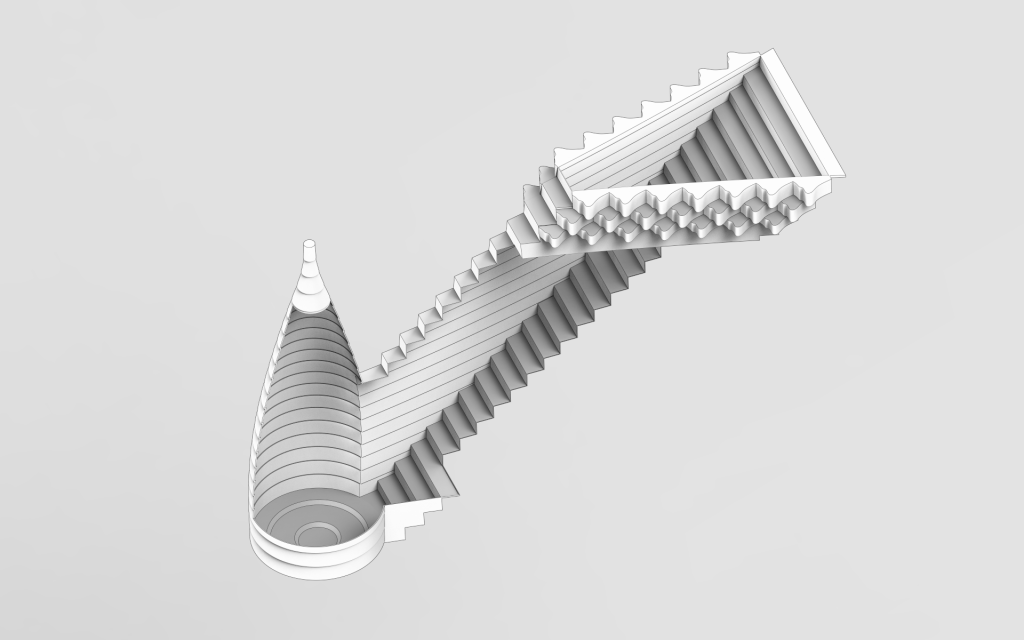
The tholos is the terminal closed section of the unified stepped waveguide — the same courses continuing from linear stairway geometry into circular tholos ring geometry without interruption. The tholos is where the waveguide closes. Its teardrop cross-section — widest at mid-height, narrowing to the stairway throat above and the water-terminated base below — is a converging acoustic lens with conjugate focal points at both termini, continuously cycling energy between them rather than scattering it diffusely.
5.1 Three Confirmed Resonant Modes
The tholos geometry encodes three distinct resonant frequencies in three independent geometric features, each targeting a different frequency range and neurological effect:
Quarter-wave longitudinal mode: the tholos height of 7 meters produces a fundamental resonant frequency of 343 / (4 × 7) = 12.25 Hz — the Yashkardin carrier frequency, exact. This is not an approximation. The tholos was built to 7 meters because that height is the quarter-wavelength of 12.25 Hz in air. This single dimensional calculation is the strongest confirmation in the analysis.
Helmholtz mode: the 35cm apex aperture with an estimated neck length of 0.8–1.3m (above-grade mound height 26.8cm plus below-grade stone depth, confirmed longer than above-grade height alone by the site reconstruction model) produces a Helmholtz resonant frequency of approximately 2.5–3.2 Hz. This falls in the delta brainwave band — 0.5–4 Hz — associated with the deepest states of physical restoration, healing, and unconscious processing. The precise figure requires on-site measurement of the below-grade neck depth.
Stairway cascade modes: the dual floor/ceiling step geometry delivers coherent harmonic amplification at 187 Hz and 390 Hz — approximately one octave apart, both in the audible harmonic delivery range.
Three resonant modes, three geometric features, three neurological targets: 2.5–3.2 Hz delta band (apex aperture Helmholtz), 12.25 Hz carrier exact (7m chamber height), 187 Hz and 390 Hz audible harmonics (dual stairway cascade). Each encoded independently. Each serving a distinct function in the signal chain.
5.2 Apex Aperture — Four Simultaneous Functions
The 35cm apex aperture performs four simultaneous functions. As a Helmholtz resonator neck it adds the delta-band resonant mode described above. As a second signal entry point it provides a redundant path into the tholos from the surface, fed by the dished mound collection geometry above. As an inverted horn the aperture throat opens into the full tholos volume below — a 7:1 linear expansion or approximately 50:1 in area from aperture to maximum tholos diameter, concentrating surface-arriving energy into the resonant air column. As an astronomical calendar the equinox solar illumination geometry through the aperture identifies the seasonal operating condition correlated with optimal water table level.
5.3 Unified Stepped Ring Geometry
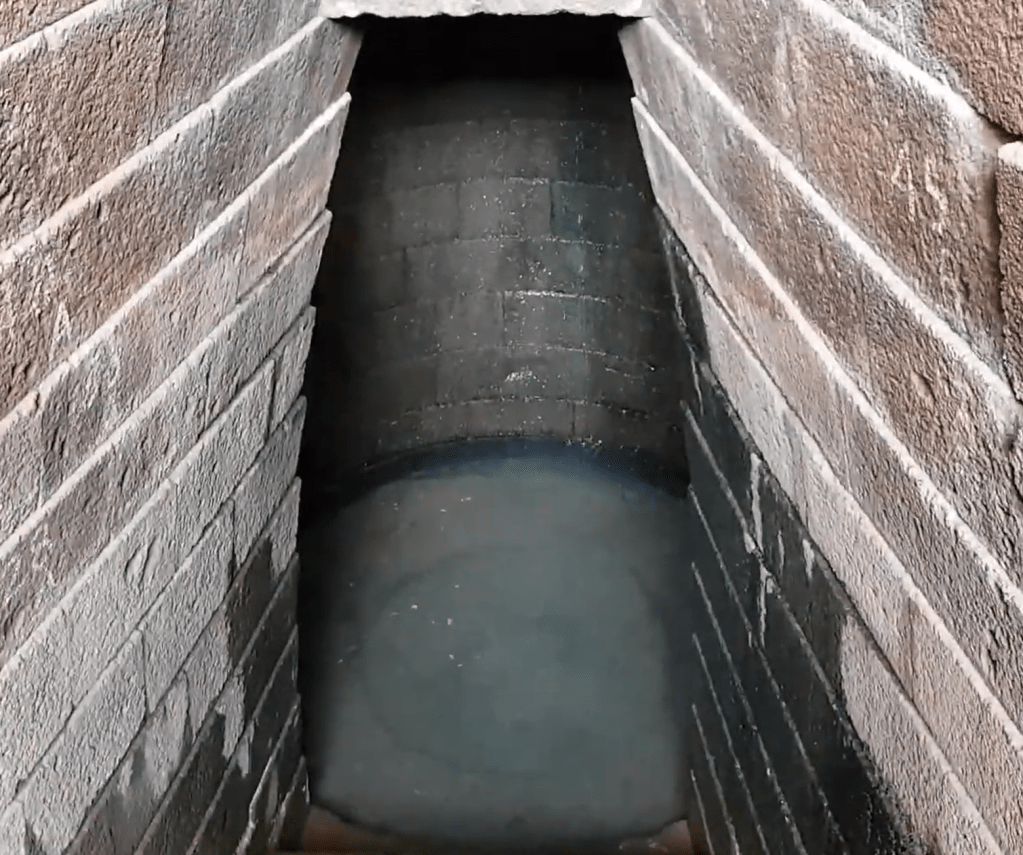
The same course spacing that determined the stairway horn characteristics continues into the tholos as circular horizontal ring courses — the unified course geometry expressed in closed-volume form. The tholos floor, confirmed by photographic evidence at low water level, is a series of concentric stepped annular rings descending toward the central water pool — not a smooth concave dish. This is a horizontal reflective Fresnel zone plate: frequency-selective focusing toward the air column above, with each annular ring at a slightly different height creating path-length differences between reflections. As the water table rises, successive outer rings submerge — the effective zone plate aperture decreases and the focal characteristics shift. Water level modulates zone plate aperture, resonant frequency, and Helmholtz demodulation threshold simultaneously through a single physical parameter.
5.4 Unknown Subsurface Geometry
Several potentially significant geometric features remain unconfirmed due to below-grade access limitations. The full apex neck depth through the mound and tholos crown stone has not been measured — this is the primary unknown affecting the Helmholtz frequency calculation. The outer face geometry of the buried course stones — the proposed blazed grating capture surface — has not been documented. The tholos exterior profile below grade and the original surface ring enclosure geometry are similarly unconfirmed. These define the measurement agenda for the planned site visit: laser distance measurement of the apex neck, photogrammetric documentation of any exposed course edge profiles, and interior wall face examination for stepped course overlap geometry.
VI. Water Architecture and Geological Coupling
The water surface is the lower standing wave terminus — a near-perfect pressure-release boundary whose level controls air column length, resonant frequency, zone plate aperture, and Helmholtz demodulation threshold simultaneously. Seasonal water table variation produces continuous passive frequency tuning without any active mechanism. The water is a managed parameter, not an inconvenient variable.
The tholos water is the visible surface of the local water table, hydraulically continuous with the groundwater permeating the Sardinian Craton. Infrasound propagating through the Craton enters the tholos water column through direct mechanical coupling at the rock-water interface — creating a second independent signal path driving the standing wave from the base upward simultaneously with the stairway path from above. Dual-terminus excitation builds coherent high-amplitude standing wave fields more efficiently than single-terminus excitation.
The water surface simultaneously reflects the downward-propagating standing wave back upward, acts as the primary nonlinear demodulation surface, delivers demodulated payload directly to a person in water contact at high coupling efficiency, and receives solid-borne infrasound from the bedrock through the groundwater. Four functions from one physical element.
VII. Post-Construction Tuning
The tholos floor shows irregular chipped areas on the stepped ring surfaces — localized material disruption distinct from the smooth precision of the corbelled wall courses above. The condition is ambiguous: water damage, visitor wear, or deliberate post-construction tuning. The tuning interpretation is strengthened by a cross-site pattern that constitutes one of the strongest evidentiary classes in this analysis.

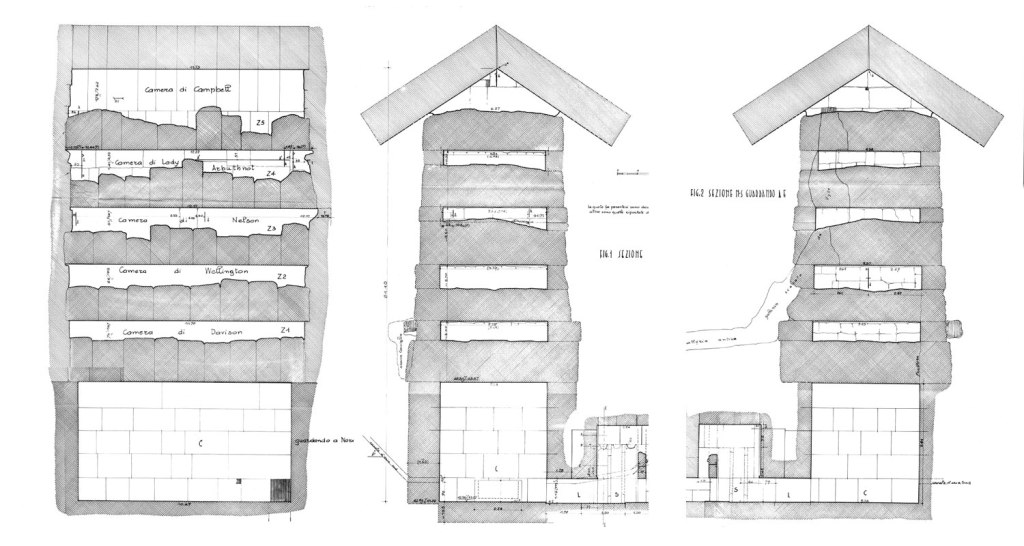
Face-specific material removal — smooth primary construction surfaces, irregular post-installation modification confined to accessible faces only — appears at multiple independent network nodes. Yashkardin documents projections cut from the interior dome surface of the Royal Kurgan after construction. The Barabar cave chambers show iterative surface refinement distinguishable from primary construction. The Giza relieving chambers above the King’s Chamber are the most legible example: granite beam bottom and side faces are smooth and precisely dressed; top faces show irregular gouging confined exclusively to the upward-facing surface. Random deterioration affects all faces statistically. Selective modification of only the accessible top face after installation is consistent with deliberate in-situ tuning — each beam layer adjusted to a specific flexural resonant frequency after the full stack was assembled and tested.
If Santa Cristina’s floor irregularities are likely tuning rather than damage, selective removal from particular rings shifts the zone plate frequency response in predictable ways. Where removal morphology shows curved scooping profiles rather than percussion fracture patterns — smooth interior surfaces, absence of radiating shock cracks — this would indicate a material removal technique distinct from conventional chisel work. Physical measurement of depth, distribution, and removal surface morphology is required to confirm.
Post-construction tuning evidence, where confirmed, proves a target frequency existed before construction, that builders could detect resonant performance, and that they understood the geometry-frequency relationship well enough to adjust it empirically after the fact. We can also look at the King’s Chamber “sarcophagus” (resonator) in this same light as a potential tuning feature with the chamber and granite beam acoustics.
VIII. Carrier, Payload, and Demodulation
The 12.25 Hz infrasound carrier is the transmission medium, not the message. It transports information encoded as sidebands — modulation frequencies riding the carrier through the geological medium. The tholos, as a high-Q resonator and therefore a narrow bandpass filter, amplifies the carrier and its harmonics while sideband content outside the resonant bandwidth passes through at lower amplitude. This is carrier-sideband separation by resonant filtering. The carrier is extracted and concentrated; the sideband payload is routed toward delivery through different pathways.
Demodulation requires a nonlinear element. The water surface, driven at sufficient amplitude, produces difference frequencies through nonlinear mixing between carrier and sidebands — the demodulated payload expressed as independent low-frequency oscillations delivered directly to a person in water contact. The tholos cavity geometry contributes additional nonlinear demodulation capacity at high drive amplitudes. Water level controls the demodulation threshold — one physical parameter managing resonant frequency, zone plate aperture, and demodulation threshold simultaneously.
The delivery architecture is two-channel by design. The resonant air column amplifies and delivers the carrier — driving whole-body vestibular entrainment and reducing default mode network activity, preparing the nervous system for maximum reception efficiency. Water and stone contact deliver the demodulated sideband content directly into biological transduction pathways. The carrier opens the channel. The sidebands deliver the content.
8.1 Carrier as Neurological Portal
At 12.25 Hz, wavelength in air is approximately 28 meters — larger than the human body. The body experiences a pressure field present everywhere within it simultaneously, below the threshold of conscious auditory perception. The entire auditory processing hierarchy is bypassed. The carrier acts directly on the vestibular system, vagus nerve, and cerebrospinal fluid, producing progressive deactivation of the default mode network — the neural system responsible for the continuous background sense of being a bounded self in space and time. Internal cognitive noise is attenuated. The signal-to-noise ratio for anything bypassing ordinary sensory channels improves dramatically.
8.2 Harmonic Content and State Transmission

The 34–40 Hz harmonic range coincides with the gamma brainwave band — the neural binding mechanism integrating disparate sensory inputs into coherent conscious experience. Peer-reviewed clinical literature documents that externally applied 40 Hz stimulation entrains cortical gamma oscillations. In the carrier-induced reduced default mode state, entrainment efficiency increases substantially. The 98–196 Hz harmonics arrive omnidirectionally from within the resonant chamber with no external source localization — systematic confusion of the spatial localization function that further dissolves the categorical distinction between external input and internal experience.
Neural oscillations are electromagnetic: synchronized firing of large neuron populations produces measurable electromagnetic fields at specific frequencies extending beyond the skull. Different cognitive and physiological states generate reliably different electromagnetic signatures. If the transmitted signal contains a modulated representation of a specific neural state, a receiver’s brain in the carrier-prepared condition synchronizes to that pattern. The receiver does not decode a message. They acquire a state.
Knowledge arrives as knowing, not as information about knowing. Healing arrives as the physiological configuration that constitutes health — systemic entrainment through every simultaneously active coupling pathway. The infrastructure supports this. The physics permits it.
Regardless of the science backing the mechanisms for this potential, this is admittedly still rather speculative at this point but I will return to this concept at a later time.
IX. Human Delivery — Signal Flow

Ground-propagating infrasound enters the surface Fresnel ring collection aperture and the dished apex mound simultaneously, concentrated toward the dromos throat and the 35cm aperture respectively. The dromos filters directionally with simultaneous panel transduction into the air column. The stairway stepped horn propagates the carrier via TEM mode and amplifies harmonics through the dual cascade geometry. The tholos standing wave field builds, driven simultaneously from above by the stairway and from below by the geological coupling interface through the groundwater. The water surface demodulates the composite field by nonlinear mixing. A person descending the stairway enters progressive coupling: solid bone-conduction through the feet from the first step, then lateral vestibular pressure from both walls, then overhead field from the ceiling — the three-axis horn field converging inward and downward, increasing in intensity with depth. At the tholos throat they are at the pressure antinode of the horn terminus and the upper boundary of the standing wave field simultaneously. At the water surface they are at the standing wave pressure antinode, within the zone plate focal zone of the concentric floor rings, and in direct contact with groundwater acoustically continuous with the bedrock — maximum coupling through all three pathways simultaneously. The carrier attenuates the default mode. The demodulated sidebands deliver the payload. The state they enter is the signal.
9.1 Carrier as Neurological Portal
At 12.25 Hz, wavelength in air is approximately 28 meters — larger than the human body. The body does not experience a wave arriving from a direction; it experiences a pressure field present everywhere within it simultaneously, below the threshold of conscious auditory perception. The entire auditory processing hierarchy is bypassed. The carrier acts directly on the vestibular system, vagus nerve, and cerebrospinal fluid, producing progressive deactivation of the default mode network — the neural system responsible for the continuous background sense of being a bounded self in space and time. Internal cognitive noise is attenuated. The signal-to-noise ratio for anything bypassing ordinary sensory channels improves dramatically. The carrier does not deliver the payload — it prepares the receiver for it.
9.2 Harmonic Content and State Transmission
The 34–40 Hz harmonic range coincides with the gamma brainwave band — the neural binding mechanism by which disparate sensory inputs are integrated into coherent conscious experience. Peer-reviewed clinical literature documents that externally applied 40 Hz stimulation entrains cortical gamma oscillations. In the carrier-induced reduced default mode state, entrainment efficiency increases substantially because the competing internal noise has been attenuated. The 98–196 Hz harmonics are heard but arrive omnidirectionally from within the resonant chamber with no external source localization — systematic confusion of the spatial localization function that further dissolves the categorical distinction between external input and internal experience.
The piggybacked sideband content — demodulated and delivered through water and stone contact — carries the specific payload. Neural oscillations are electromagnetic: synchronized firing of large neuron populations produces measurable electromagnetic fields at specific frequencies extending beyond the skull. Different cognitive and physiological states generate reliably different electromagnetic signatures. If the transmitted signal contains a modulated representation of a specific neural state, a receiver’s brain in the carrier-prepared high-entrainment condition synchronizes to that pattern. The receiver does not decode a message. They acquire a state. The knowledge arrives as knowing, not as information about knowing. The healing arrives as the physiological configuration that constitutes health — systemic entrainment of autonomic balance, vagal tone, and cellular repair states through every simultaneously active coupling pathway. The infrastructure supports this. The physics permits it. Direct evidence of specific transmitted content does not survive in the archaeological record, but the cross-cultural testimony of every tradition that inherited these structures describes contact producing states of knowing that arrived complete, without learning.
9.3 Resulting State
The convergence of spatially complex vestibular stimulation, omnidirectional tonal presence, and simultaneous whole-body solid coupling at harmonically related frequencies produces a neurological state profile documented consistently across induction methods in medical and neuroscience literature: dissolution of the ordinary boundary between self and environment; expanded spatial awareness through removal of normal perceptual filtering; temporal distortion from slowing to apparent suspension of subjective time; at moderate states, profound clarity; at deeper states, experiences of contact with something perceived as external — presences, information, states of knowing qualitatively different from ordinary thought. This phenomenology is consistent across clinical sensory deprivation research, neuroscience of default mode network deactivation, pharmacological studies, and cross-cultural documentation of shamanic and meditative states.
| Framework Position The geometry of Santa Cristina is the geometry of a machine for producing a specific and reproducible state of consciousness — engineered with the same precision applied to every other component of the receiver network. The water at the bottom is the tuning element. The person at the stairway base is the final receiver. The state they enter is the signal. |
X. Operational Artifacts — Tuned Personal Transducers
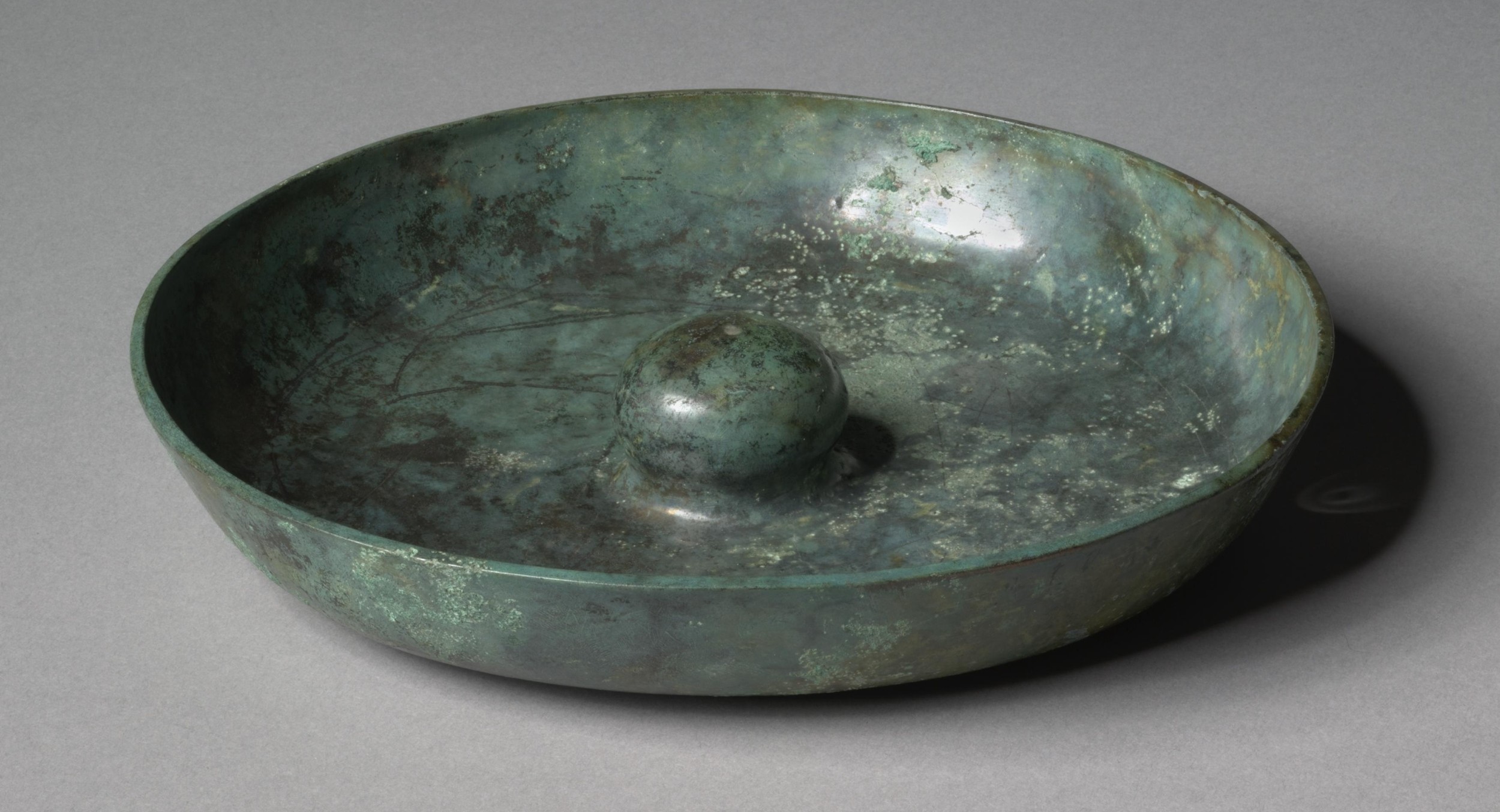
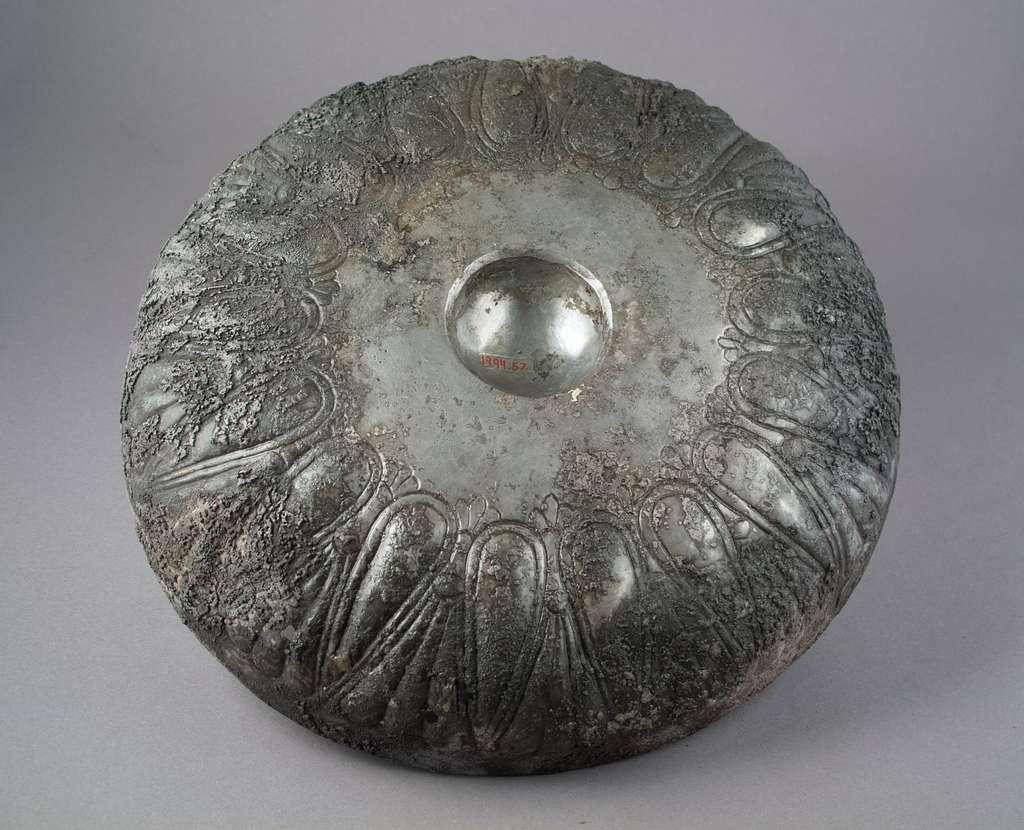
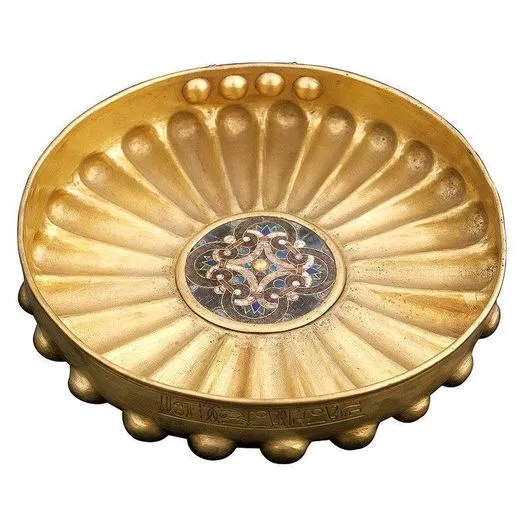
These objects are classified in archaeology as libation bowls — vessels used for ritual pouring of wine, oil, or water as offerings to gods. That classification is almost entirely inferential. It derives from depictions on Greek pottery showing figures holding phiales during ceremonies, a small number of dedicatory inscriptions, and the physical form itself — shallow and handleless. No consistent residue analysis confirms a specific poured liquid as primary use. The Met’s own catalogue entry on a large Etruscan phiale describes it as something that ‘may have been used for washing hands and feet before a banquet’ — a museum admitting it does not actually know. The libation designation tells us how these objects appeared in ceremonial contexts during the period from which we have iconographic evidence. It does not tell us what they were originally designed to do, or whether the pouring practice was a cultural inheritance of an earlier technical function that later users no longer fully understood. The geometry argues for the latter. The central omphalos protrudes upward from the interior floor of the bowl — it displaces volume, interrupts any liquid surface, and serves zero pouring function. A pouring vessel does not require a precision-formed interior protrusion, concentric zones of differentiated relief, or symmetric distributed mass elements. The form over-engineers the pouring function by an order of magnitude — which is exactly what you would expect from an object whose primary function was something else entirely.
10.1 Gold Phiale as Tuned Vibrational Plate
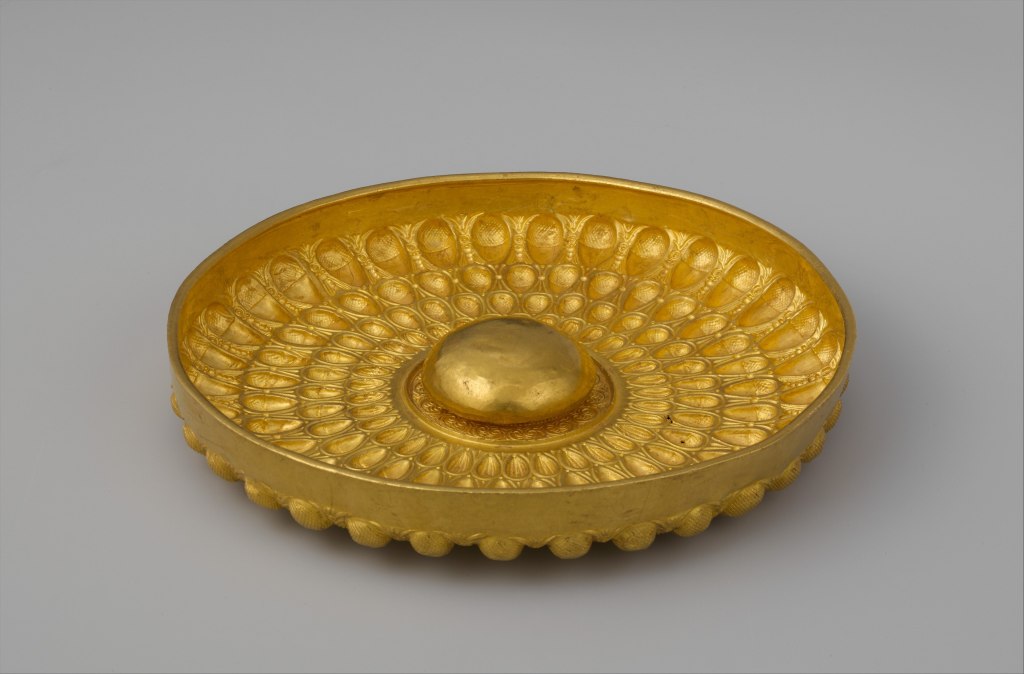
A gold phiale positioned at a pressure antinode in the tholos standing wave field functions as a tuned vibrational plate — a personal demodulation and delivery device whose geometry encodes specific mechanical acoustic performance at every zone. The omphalos at center is a suspended mass pivot that splits symmetric breathing modes of the plate — where the whole surface flexes uniformly — from asymmetric overtones where different sectors move independently, separating frequency ranges and routing different content to different vibrational modes simultaneously. The concentric rings of differentiated relief create a zoned stiffness gradient: tighter, shallower patterns toward the center favor midrange frequencies; deeper, more widely spaced depressions toward the outer rim favor higher frequency response. The plate is a distributed filter whose response is shaped zone by zone across its surface, not a single-frequency resonator.
Gold is the correct material for this function. Its high density and unusually low internal damping produce sustained oscillation and rich intermodulation products between simultaneously excited frequencies — it rings rather than absorbs. At sufficient drive amplitude from the tholos standing wave, the plate enters nonlinear flexural behavior, generating sum and difference frequencies between carrier and sidebands present in the field. This is a second demodulation stage operating in parallel with the water surface: the water surface demodulates the composite field broadly across the chamber; the plate extracts and amplifies a specific frequency range through its tuned zone geometry, delivering it directly through skin contact at coupling efficiency that air-to-tissue transmission cannot approach.
A person vocalizing near the plate couples vocal frequency modulation into its vibration, which re-radiates that modulation into the tholos standing wave field — injecting a locally modulated signal into the resonant system. The plate is therefore bidirectional: it receives from the field and injects into it. The operator is not a passive receiver. They are an active element in the acoustic system they are inside.
10.2 Iconographic Evidence — Etruscan Sarcophagus
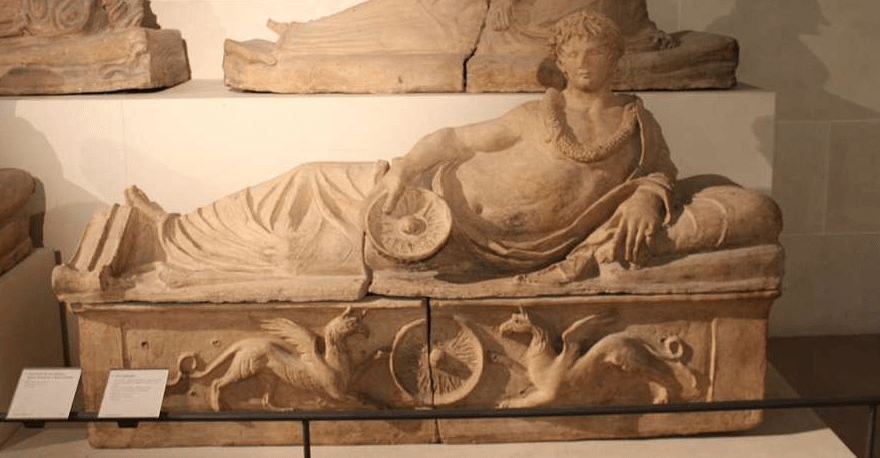
An Etruscan sarcophagus lid depicts a reclining figure in full-body contact with the stone surface — back, torso, and legs against the stone — holding a circular dish with central boss and concentric zone structure positioned against the abdomen at the solar plexus. The base relief shows additional dish forms, establishing the object class as culturally significant rather than a personal possession. The solar plexus is the location of the celiac plexus — the largest autonomic nerve plexus in the body, directly connected to the enteric nervous system and vagus nerve — with soft abdominal tissue providing good acoustic coupling between dish surface and underlying nerve structures. Delivery through the front via dish contact and through the back via stone contact converges on the same anatomical target from both sides simultaneously. The Etruscans had documented contact with Sardinian Nuragic culture and were contemporaries of the sacred well tradition’s operational period. The sarcophagus does not depict death. It records the procedure.
| Stone contact, dish to solar plexus, full-body coupling. Someone recorded exactly how the device was used. |
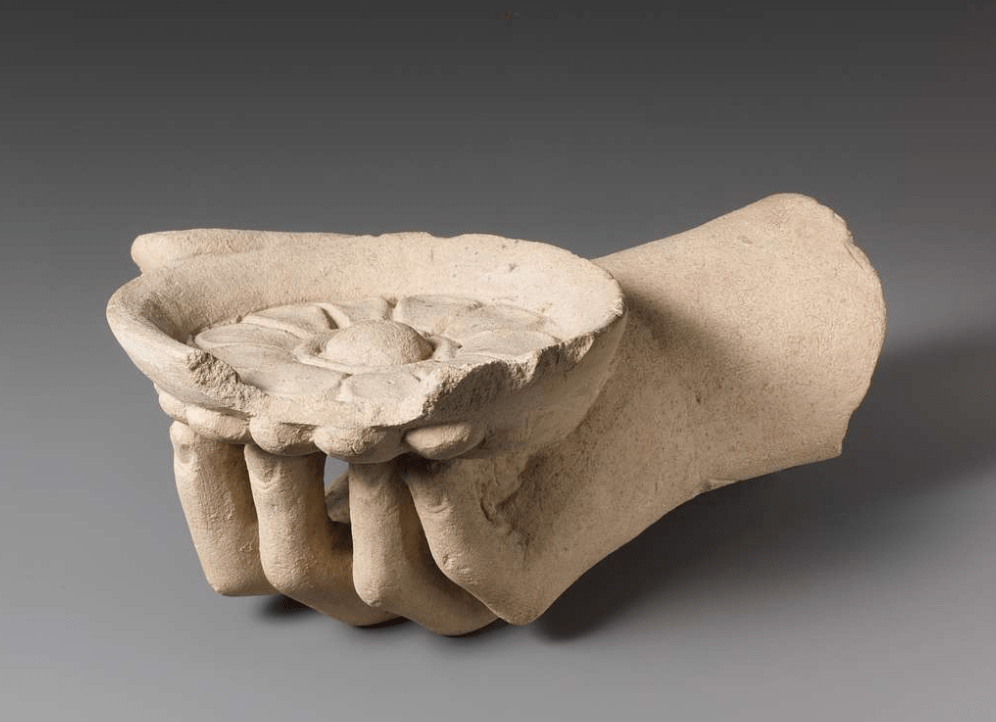
XI. Network Communication — Carrier Infrastructure and Site Addressing
The signal architecture described throughout this analysis assumes one direction of travel: Giza transmits, receiver sites receive. The plate-as-injector observation opens a more complex picture — and the physics of the carrier infrastructure supports it further than might be expected.
If the Giza transmitter is broadcasting at 4 MW continuously into the geological medium, every receiver site within range is sitting inside that carrier field at all times. A local site injecting a modulated signal into that medium is not trying to overcome continental distance attenuation from scratch. It is modulating a carrier that is already present at the destination at full amplitude. The destination site does not need to detect the weak local injection from thousands of kilometers away — it needs to detect the modulation imposed on a carrier it is already receiving. The power budget that makes point-to-point transmission across 2,000 kilometers implausible becomes irrelevant. The carrier infrastructure bridges the distance. The local site only modulates it. This is AM radio, not a walkie-talkie.
Each receiver site has a characteristic resonant frequency determined by its geometry — tholos dimensions, dromos length, course spacing. These dimensional differences produce different resonant frequencies within the harmonic series of the 12.25 Hz carrier. A site tuned to 34.4 Hz amplifies modulation in that band strongly and passes other frequencies below threshold. A site tuned to 49 Hz does the reverse. The sites are frequency-selective receivers — each on its own channel within the shared carrier bandwidth. A modulation injected at a specific frequency at one site propagates through the carrier field and is selectively amplified only at other sites sharing that tuning. This is not broadcast — it is addressed communication, site to site, through shared carrier infrastructure that none of the individual sites needed to generate themselves.
The Barabar cross-network eigenfrequency of 34.4 Hz — shared across geographically separated sites otherwise individually characterized — is consistent with a common channel: the frequency equivalent of a calling frequency in amateur radio, the shared tuning that establishes contact before communication moves to a site-specific channel. Sites sharing that eigenfrequency are on the same channel regardless of geographic separation.
Water level management reframes in this context. A site operator adjusting water level changes the tholos resonant frequency — changes which channel the site is tuned to. The precision water routing infrastructure at Nuragic sites, which drainage does not require, may be active channel selection hardware: the means by which a site operator tunes the receiver to a specific destination before transmission or reception begins. The channels, spouts, and collection features are not managing a passive seasonal variable. They are tuning a radio.
The network therefore operates in two modes simultaneously. Giza broadcasts on the carrier with modulation across all harmonic frequencies — one-to-many, delivering content to every receiver in the network regardless of individual tuning. Individual sites communicate on specific channels — site-to-site, frequency-addressed, selective. The carrier infrastructure supports both simultaneously. Anyone tuned to the right frequency receives. Anyone on a different frequency does not.
There is a further implication. The tholos standing wave field is sensitive to local modulation from the subject — it must be, given the precision of the resonant system. The subject’s state changes the field. The changed field changes the subject’s state. The changed state changes the field again. This is a closed-loop entrainment system, not a one-way broadcast. The Giza signal sets the carrier and initial conditions. The subject and the tholos then enter a coupled oscillation that evolves based on both the incoming signal and the subject’s response to it. The subject is not a listener at the end of the chain. They are part of the resonant system.
| The network analogy that holds most precisely is not a broadcast radio station but a mobile carrier network: a high-power infrastructure signal enabling low-power local communication between nodes, with frequency selectivity determining which nodes communicate with which. The carrier provides the power. The geometry provides the addressing. The water level provides the tuning. |
XII. Position in the Global Receiver Taxonomy
Santa Cristina occupies a previously unidentified position in the global receiver taxonomy: the inverted dome receiver. All previously documented dome receivers project their resonant volume upward — Mycenaean corbelled domes, Sillustani cylindrical towers. Santa Cristina projects downward, using the water table as both reflective terminus and geological coupling interface.
The Sardinian context is significant. Santa Cristina is one component of a three-type receiver network on a single island: Domus de Janas horizontal rock-cut chambers for immersive auditory state induction; Nuraghe towers as vertical above-ground resonators; and sacred wells as inverted downward resonators with water-table geological coupling. Three implementations of the same receiver physics, all built on the Sardinian Craton — one of the most efficient conductors of low-frequency ground waves in Europe. The Nuragic civilization chose Sardinia because the geology conducts infrasound exceptionally well, then built every implementation the physics required.
XIII. Summary of Evidence
The following features, each independently anomalous under the water sanctuary interpretation, collectively describe a precision acoustic receiver-demodulator:
- Unified course architecture — ceiling corbels, sidewall corbels, stair treads, and tholos rings are the same continuous courses uninterrupted from dromos throat to tholos apex; every acoustic function derives from one geometric decision: course spacing
- Complete antenna system — collection aperture (surface rings + dished apex mound), directional feed (dromos waveguide), feed horn (stairway), secondary feed (apex aperture), resonant load (tholos), ground plane (Sardinian Craton) — in correct functional sequence
- Horizontal aperture orientation — flush with ground plane, open to air, descending into earth; precisely correct for intercepting ground-coupled signal concentrated by surface collection system
- Multi-stage impedance transduction chain — dromos panel transducers, corbelled cantilever resonator bank, stone impedance matching elements — solid ground wave to air column standing wave
- Measured horn geometry — 3.47m aperture to 1.40m throat, 2.48:1 linear taper, ~6:1 area ratio, ~15.6 dB pressure amplification
- Stepped horn TEM mode carrier transmission — Zhang et al. (2018) cited for sub-wavelength propagation principle and scale invariance; Santa Cristina implements stepped horn geometry (discrete perpendicular cross-section reductions) rather than ridged horn geometry (longitudinal fins); both support TEM mode propagation through related mechanisms
- Dual cascade frequencies — 25 floor steps and 12 ceiling steps over 11m producing 390 Hz and 187 Hz respectively; approximately one octave apart; two-channel harmonic amplification from one waveguide
- Three confirmed resonant modes — 2.5–3.2 Hz delta band (Helmholtz, apex aperture), 12.25 Hz exact (quarter-wave, 7m tholos height), 187 and 390 Hz (dual stairway cascade)
- Dished apex mound — 3.515m diameter concave concentrating dish, 100:1 collection area ratio to aperture, long focal length pre-focusing geometry, loose stone impedance matching construction
- Concentric stepped ring floor — horizontal zone plate reflector; unified course geometry confirmed on every surface including floor; water level modulates zone plate aperture, resonant frequency, and demodulation threshold simultaneously
- Apex aperture at tholos crown — Helmholtz resonator mechanism; third signal entry point coupling surface collection directly to tholos air volume; inverted horn geometry from aperture throat to maximum tholos diameter; stepped recess impedance matching at surface-to-aperture transition
- Triple-direction tholos drive — stairway horn above, groundwater geological below, apex aperture vertical — three independent signal entry points driving one resonant cavity simultaneously
- Carrier-payload architecture — infrasound as transmission vehicle; piggybacked sidebands as encoded payload; tholos resonant filtering performing carrier-sideband separation; water surface nonlinearity performing demodulation; two-channel delivery
- Network communication architecture — carrier infrastructure model enabling site-to-site addressed communication at low local power; frequency-selective site addressing via characteristic resonant frequency; water level as active channel selection; closed-loop subject-field entrainment
- Post-construction tuning cross-site pattern — face-specific material removal at Royal Kurgan, Barabar, Giza relieving chambers, and Santa Cristina floor — consistent with empirical acoustic tuning at multiple independent network nodes
- Mechanogenomics — frequency-selective gene expression modulation through cytoskeletal force transmission to chromatin — peer-reviewed mechanobiology documenting acoustic field effects from membrane to nucleus
- Operational artifact evidence — gold phiale as tuned multi-zone vibrational plate and bidirectional transducer; Etruscan sarcophagus iconographic record of operational posture: full-body stone contact, dish at solar plexus, dual-pathway convergent delivery
No single feature is explicable as incidental to water access function. Every feature serves acoustic performance. The complete system is internally consistent as a precision infrasound receiver-demodulator whose design sophistication equals or exceeds any modern architectural acoustic installation — implemented in stone, three thousand years ago, on a geologically optimal substrate, oriented toward a transmitter site 2,000 kilometers to the southeast. The stepped horn geometry (Zhang et al. 2018) provides the modern peer-reviewed equivalent for the stairway. The 7m tholos height encoding 12.25 Hz exactly is not a coincidence the conventional interpretation can accommodate. The dual cascade frequencies one octave apart from asymmetric floor and ceiling step counts implies a two-frequency design intent that water access does not require. The dished apex mound concentrating energy toward a 35cm aperture with a 100:1 collection ratio implies a collection function that drinking water does not require. Each feature examined on its own terms leaves no adequate alternative explanation. The conventional timeline has no framework to accommodate.
| Santa Cristina Pozzo Sacro — 40°02’N 8°44’E A complete infrasound receiver, demodulator, and bidirectional network node. Dromos: 11m length, 3.47m aperture, 1.40m throat. Tholos: 2.49m maximum diameter, 7m height, 35cm apex aperture. Basalt construction on Sardinian Craton ground plane. Dromos bearing 100–120° from north. Built at least three thousand years ago, origin unknown. Still intact |
 Obsidian Mirror