

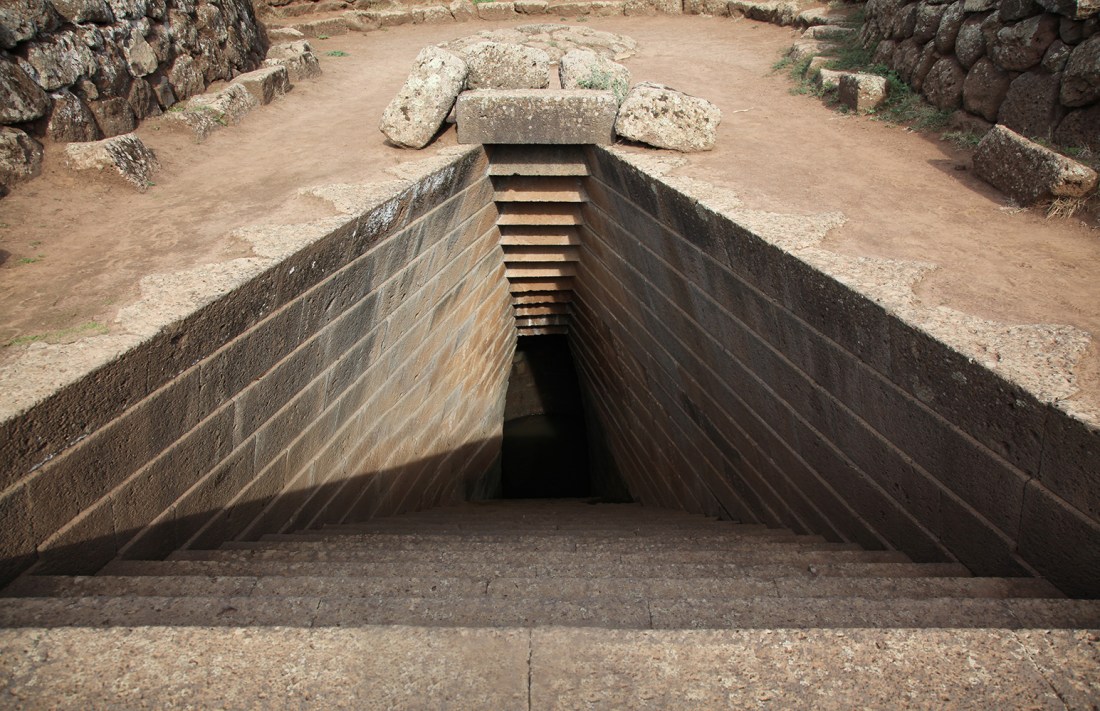
Upon first seeing Santa Cristina well in Sardinia, I was immediately struck by the accuracy and complexity of the descending passageway — the stepped corbelled ceiling, the trapezoidal converging shape, and the precise protruding corbelled edges of the walls. Something about the level of precision and deliberateness stopped me. This was not rough ancient construction. Every surface was doing something.
I am an industrial designer — a discipline that is engineering-adjacent by necessity. My job is to read objects for evidence of intent — to ask what a thing was solving, what the geometry requires, and where the precision exceeds what the stated function demands. The Sacred Well of Santa Cristina in Sardinia has been classified for decades as a Nuragic ritual water sanctuary. When I applied a designer’s lens to what I was seeing, that interpretation collapsed almost immediately.
None of these features are required by a “primitive” water access function. All of them are required by a precision acoustic receiver.
The full analysis connects Santa Cristina to a broader network of sites across the ancient world that share the same design logic — and explores what that network may have been designed to do.

 Obsidian Mirror